










America 250 Virtual Exhibit
-click any image to enlarge-
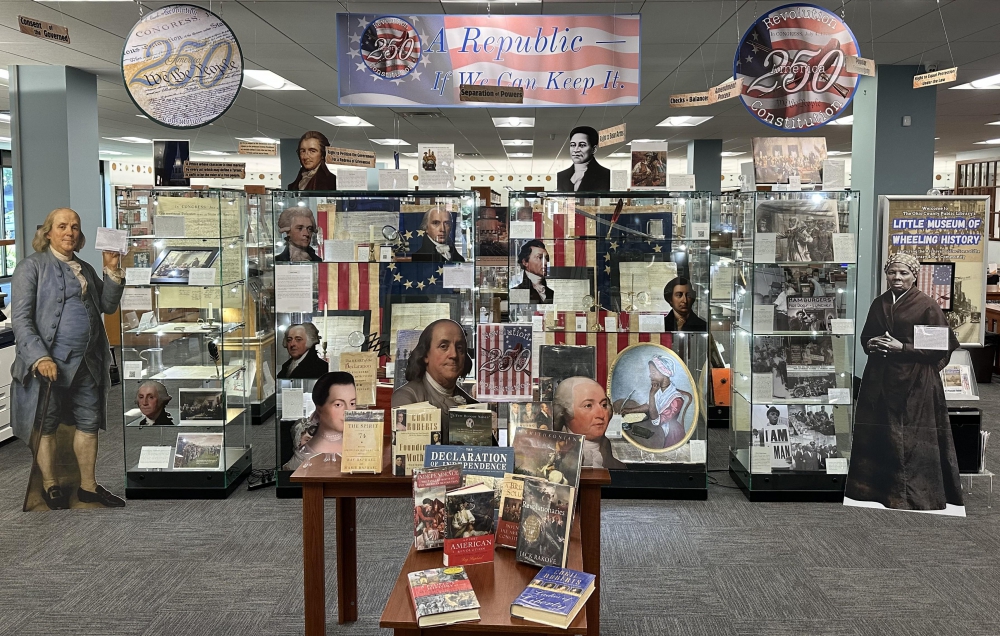
On September 17, 1787, as the Constitutional Convention in Philadelphia finished its vital and contentious work, Ben Franklin was asked whether the delegates had created a monarchy or a republic. “A republic,” Franklin famously replied, “if you can keep it.” Franklin’s words remind us that self-government is fragile and difficult and must be guarded diligently, especially by the governed. And that is the reason our America 250 exhibit was named for Franklin’s keen insight, based as it was on many years of wisdom and experience.
Benjamin Franklin
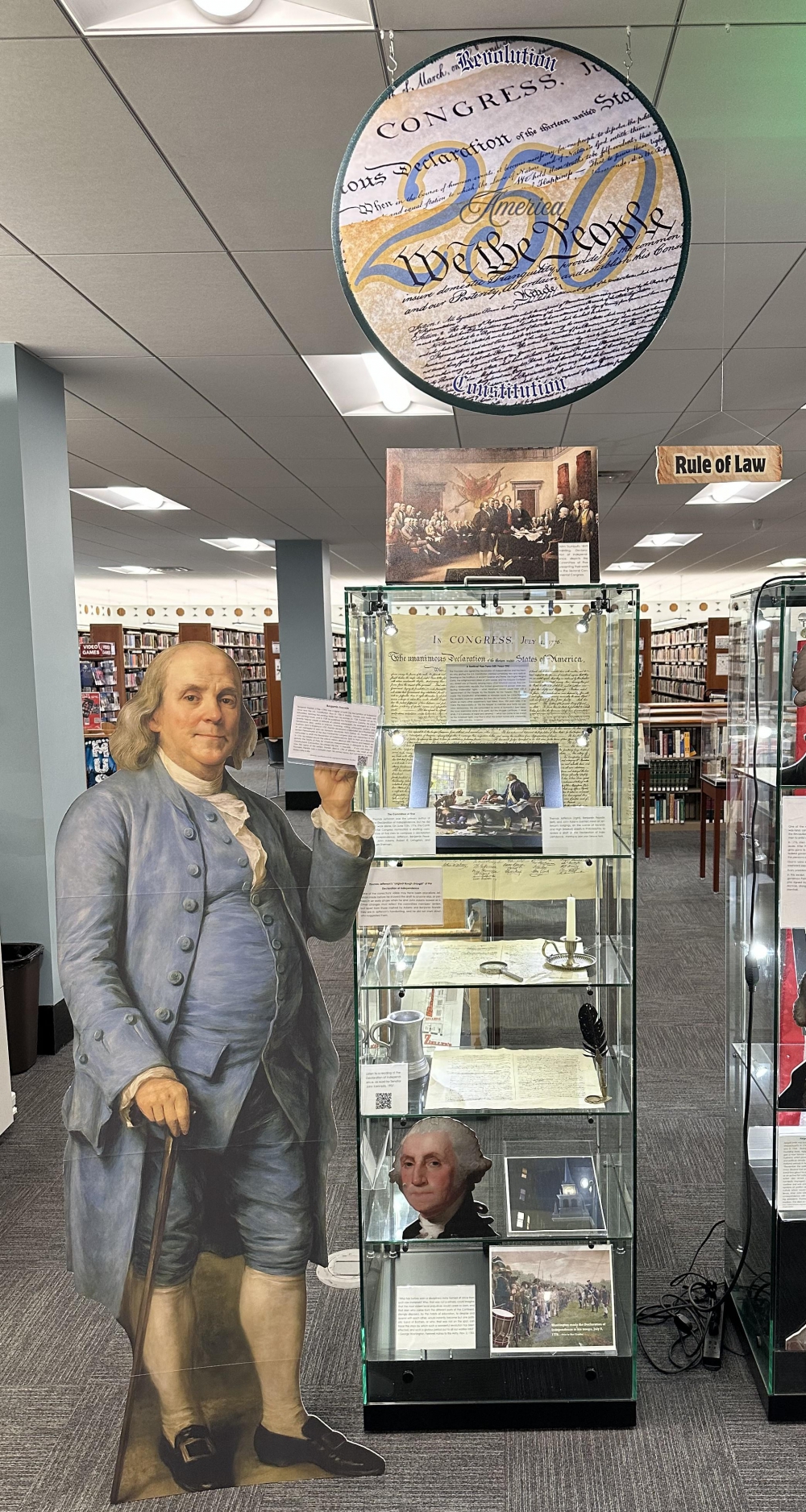 Benjamin Franklin (1706—1790) was a signer of both the Declaration of Independence and the U.S. Constitution. Born in 1706 in Boston, Franklin was mostly self-educated, learning the printing trade from his brother. In 1728, Franklin set up his own printing house, and in 1729 he published The Pennsylvania Gazette. He subsequently helped create a network of colonial newspapers. He emerged as a true Renaissance Man, active in science, inventing, writing, philosophy, politics, and business. Sent to England in 1757, Franklin developed a reputation as a troublemaker, yet managed to earn an honorary doctorate from Oxford. Dr. Franklin represented Pennsylvania at the 2nd Continental Congress and was appointed to the committee to draft the Declaration of Independence. Sent to Paris as a diplomat in 1776, he helped secure the critical military alliance with France and helped negotiate the Treaty of Paris for American Independence. A delegate to the 1787 Constitutional Convention, he uttered the line “A Republic — if you can keep it,” now the name of this exhibit. Franklin died in 1790 of pleurisy. Like most of the Founders, Franklin was a complex man. He owned slaves, but converted to abolitionism later in life. SOURCE
A Radical Plan Turns 250 Years Old
The Founders who signed the Declaration of Independence and the Framers who drafted the U.S. Constitution created something new and radical. Drawing on the traditions of ancient Greece and Rome, the English Magna Carta, the enlightenment ideas of John Locke, and the Iroquois Confederacy (Great Law of Peace), among many other historical sources, they created a democratic republic that limited governmental powers while protecting ‘inalienable’ rights — what Abraham Lincoln would later call a ‘government of the People, by the People, for the People.’ The Framers made the Constitution amendable so mistakes could be corrected and the obsolete could be updated. But they did not know if it would succeed where so many other experiments had failed. Now, 250 years later, it remains the responsibility of ‘We the People’ to maintain and fortify our precious democracy. We are surrounded by some of humanity’s best ideas. We have overcome some of its worst. But the struggle continues. It never ends. It is a process of hope and renewal — what has come to be known as the American Spirit. And that is what this exhibit honors and celebrates. Happy 250th birthday, America!
The Declaration of Independence
Our first display case features the Declaration of Independence, in which the Primary author, Thomas Jefferson and the "Committee of Five" detail grievanes against King George III that compel the colonies "to dissolve the political bands which have connected them with another, and to assume among the powers of the earth, the separate and equal station to which the Laws of Nature and of Nature's God entitle them ..."
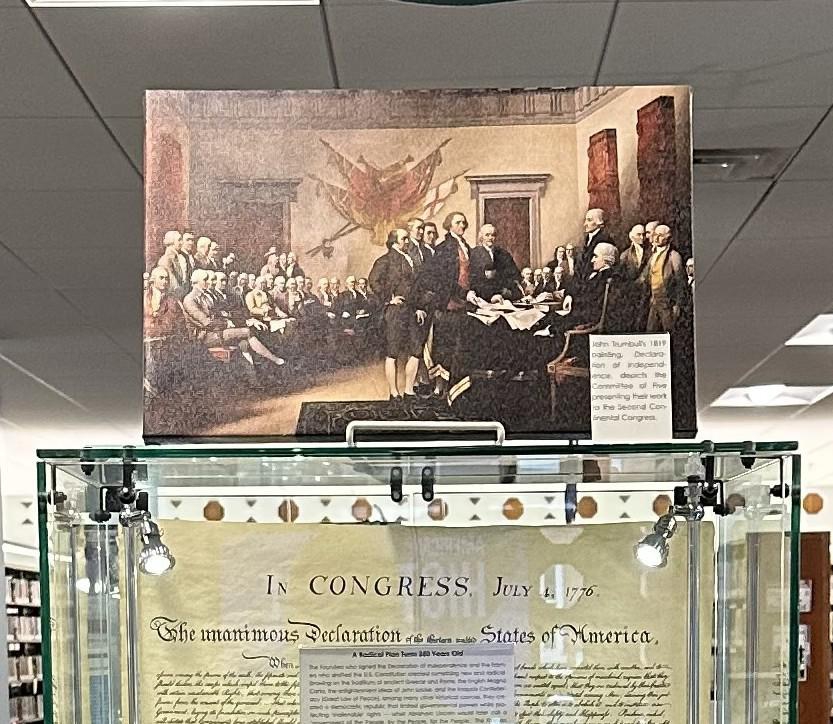 Atop the case we see John Trumbull's 1819 painting, Declaration of Independence, which depicts the Committee of Five presenting their work to the Second Continental Congress.
The Committee of Five
The Committee of Five of the Second Continental Congress was a group of five members who drafted and presented to the full Congress in what would become the United States Declaration of Independence of July 4, 1776. The committee was composed of John Adams, Benjamin Franklin, Thomas Jefferson, Robert Livingston, and Roger Sherman.
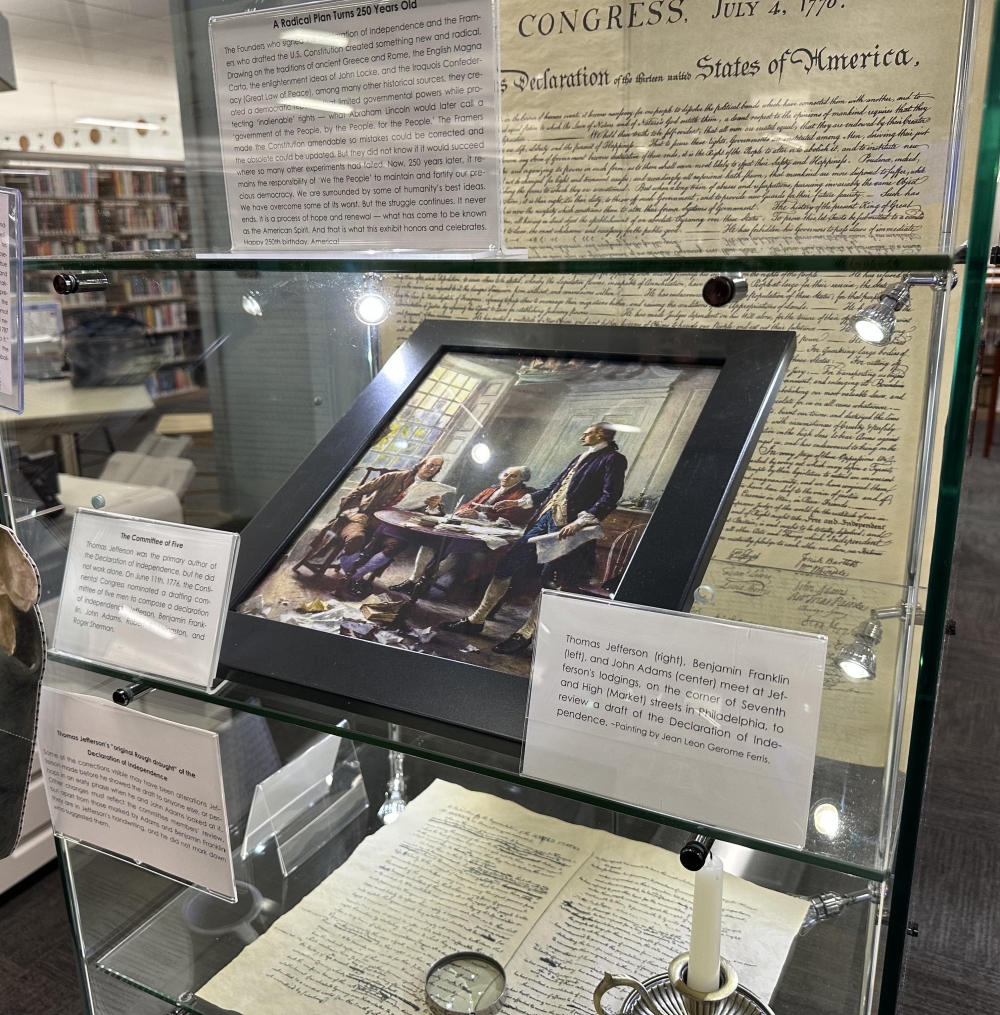 We then see this painting by Jean Leon Gerome Ferris, showing Thomas Jefferson (right), Benjamin Franklin (left), and John Adams (center) meeting at Jefferson's lodgings, on the corner of Seventh and High (Market) streets in Philadelphia, to review a draft of the Declaration of Independence.
Also visible is a replica of Jefferson's "original Rough draught" of the Declaration of Independence. Some of the changes we see may have been alterations Jefferson made before he showed the draft to anyone else, or perhaps in an early phase when he and John Adams looked at it. Other changes must reflect the committee members’ review, but apart from those marked by Adams and Benjamin Franklin they are in Jefferson’s handwriting, and he did not mark down who suggested them. SOURCE
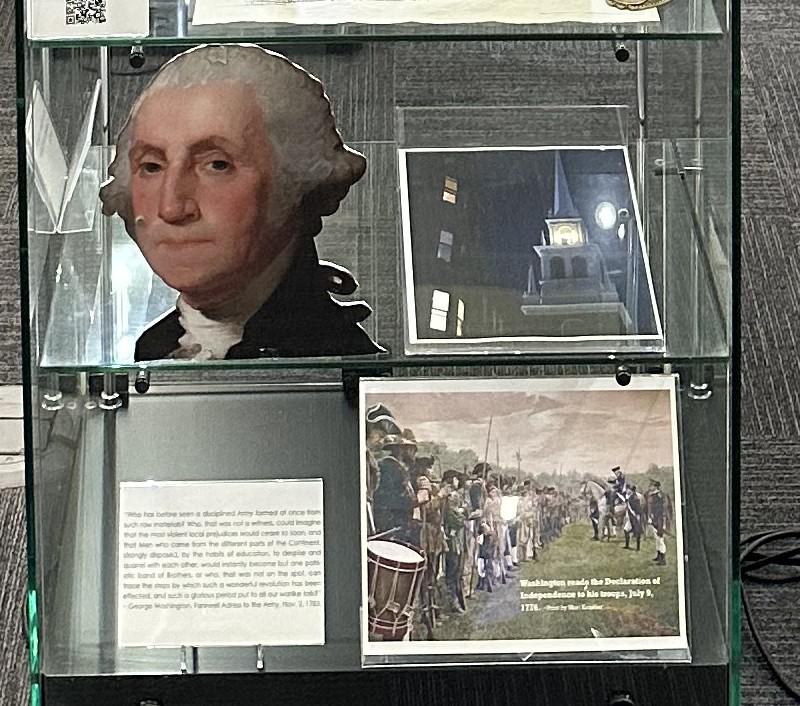 At the bottom of the case, we see General Washington on horseback in New York reading the Declaration of Independence to the troops in a painting by renowned historical artist Mort Künstler.
"For who has before seen a disciplined Army form’d at once from such raw materials? Who, that was not a witness, could imagine that the most violent local prejudices would cease so soon, and that Men who came from the different parts of the Continent, strongly disposed, by the habits of education, to despise and quarrel with each other, would instantly become but one patriotic band of Brothers, or who, that was not on the spot, can trace the steps by which such a wonderful revolution has been effected, and such a glorious period put to all our warlike toils?" ~From Washington's Farewell Address to the Army, 1783
Hear Senator John F. Kennedy read the Declaration in 1957.
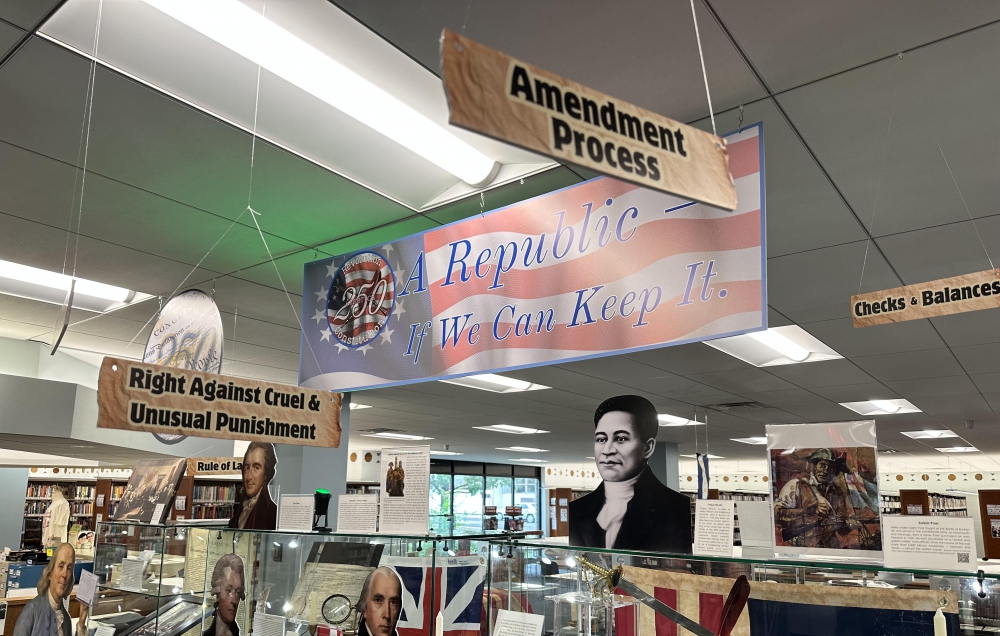
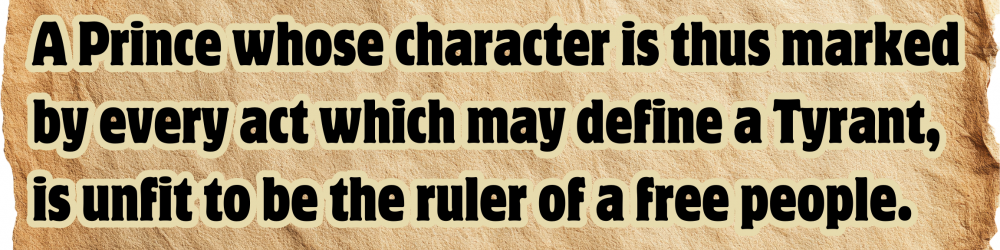
Hanging above the exhibit, and spinning in space like an 18th century version of The Cloud, are small parchment signs displaying many of the key words and phrases from both the Declaration of Independence and Constitution. Please take the time to look up, read these words and refelect upon their meaning and importance to our republic. They form the blueprint.
Learn more from the National Constitution Center:
More about the Declaration of Independence
 The Grand Union Flag
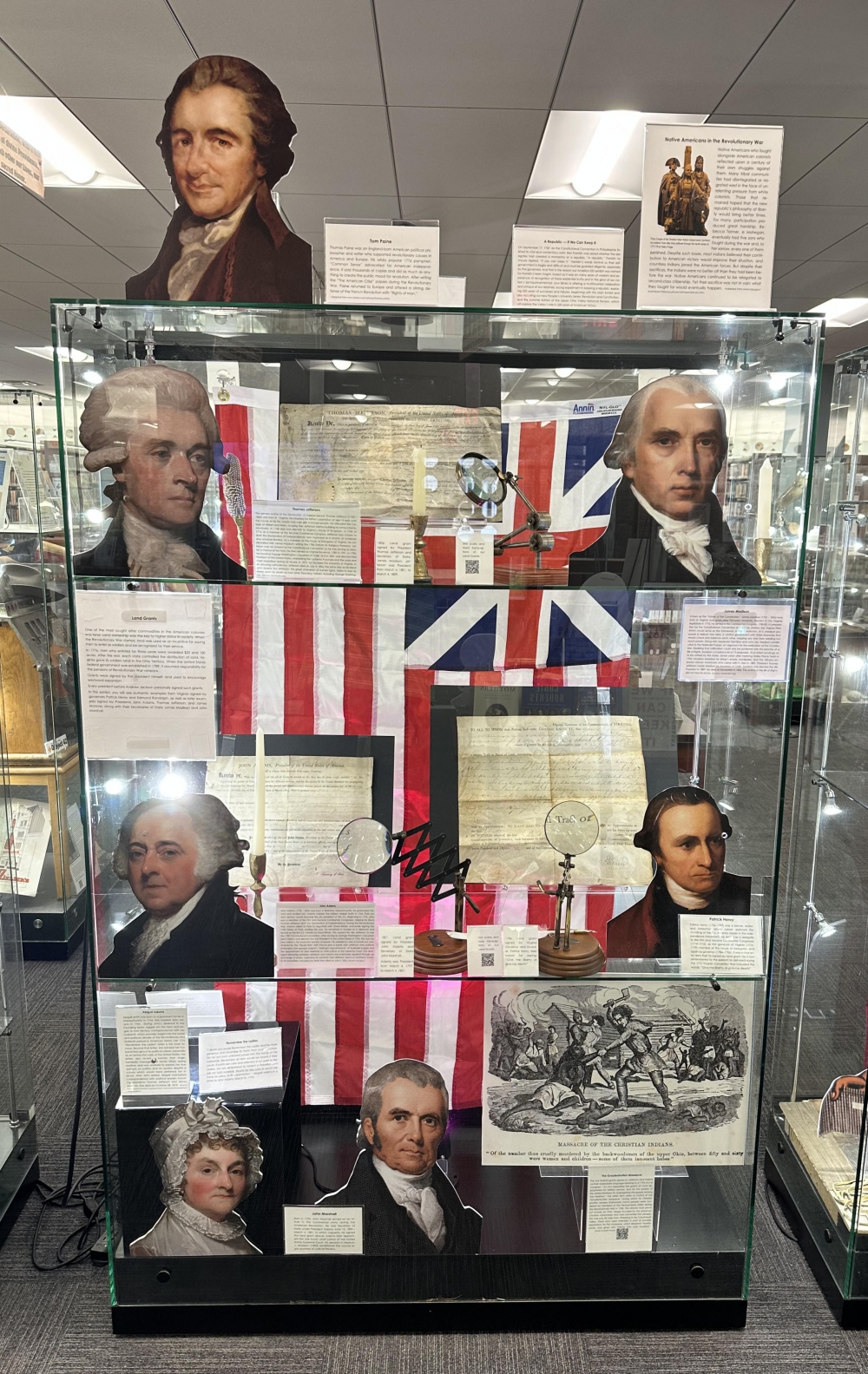
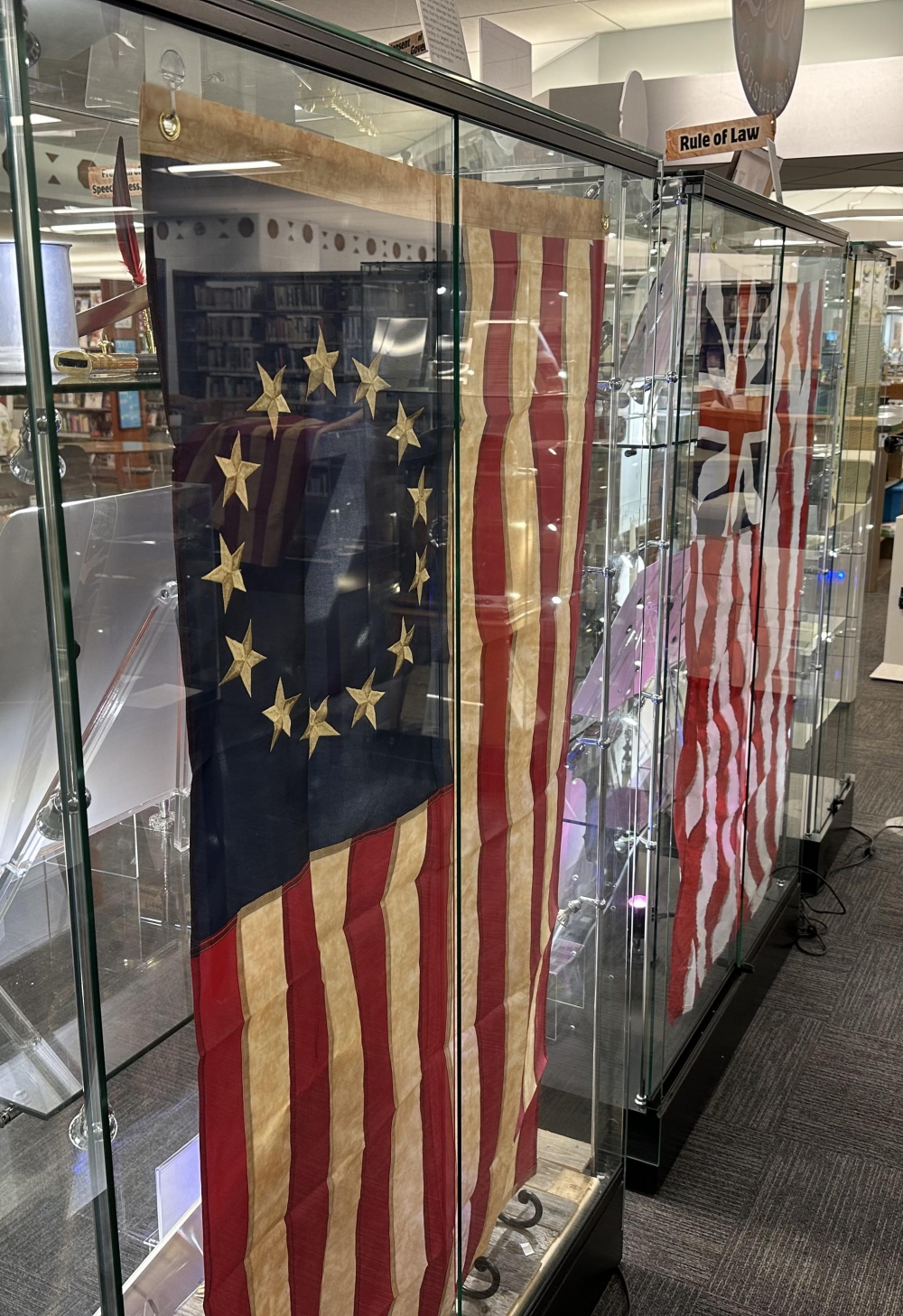
Forming the background of the first large display case is America's first flag, the Grand Union Flag (aka Continental Colors), which was first unfurled in the early days of the American Revolutionary War. Combining the British Union Flag with thirteen alternating red and white stripes, its unique design signified the colonies' solidarity and connection to the mother country. Raised by George Washington in 1776, It was discontinued after passage of the Flag Act by the Continental Congress in 1777.
Tom Paine
Atop this case at left is a portrait of Tom Paine. He was an English-born American Founder, whose pamphlet Common Sense (1776) sold thousands of copies and did as much as anything to change minds about the need for Independence. Paine's writings advanced Enlightenment-era arguments for human rights that influenced both the American and French Revolutions.
Native Americans in the Revolutionary War
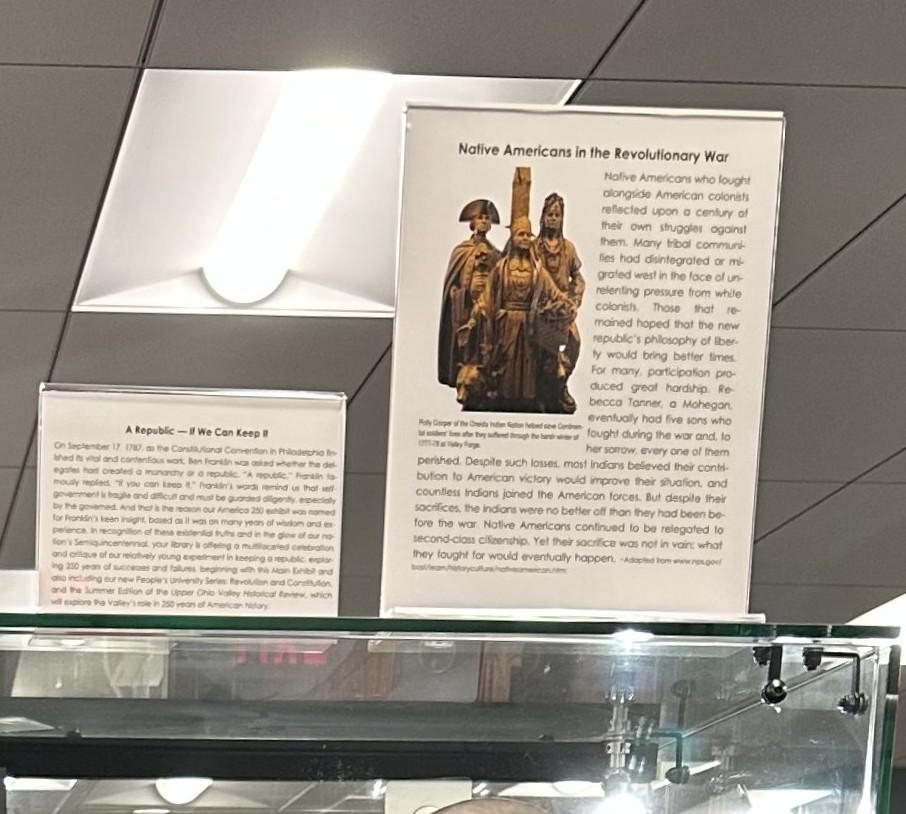
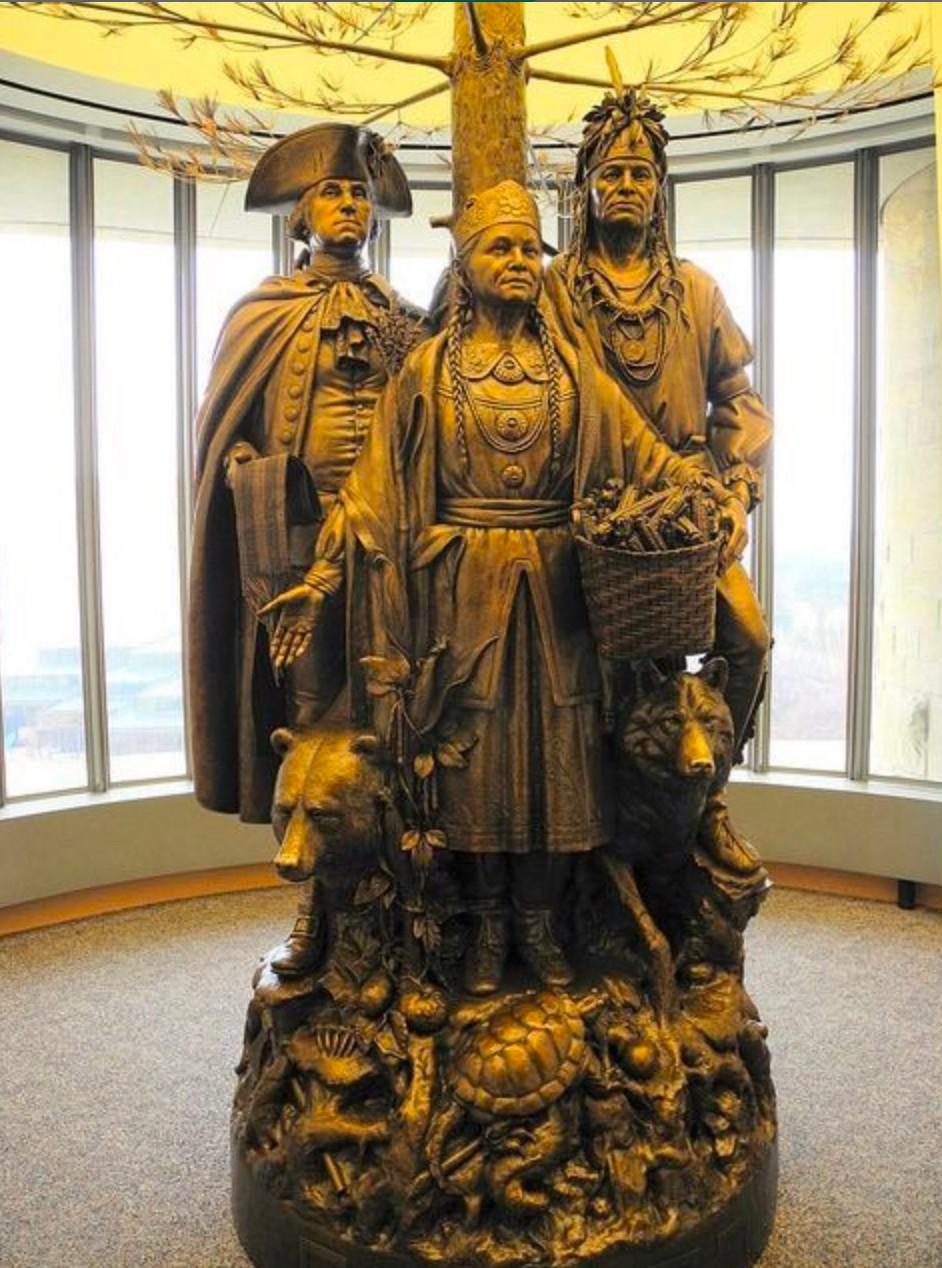 At right atop this case, we acknowledge the Native Americans who fought in the American Revolution. Many, including the Mohawk Joseph Brant, sided with the British. Native Americans who fought alongside American colonists reflected upon a century of their own struggles against them. Many tribal communities had disintegrated or mi-grated west in the face of unrelenting pressure from white colonists. Those that remained hoped that the new republic’s philosophy of liberty would bring better times. For many, participation produced great hardship. Rebecca Tanner, a Mohegan, eventually had five sons who fought during the war and, to her sorrow, every one of them perished. Despite such losses, most Indians believed their contri-bution to American victory would improve their situation, and countless Indians joined the American forces. But despite their sacrifices, the Indians were no better off than they had been be-fore the war. Native Americans continued to be relegated to second-class citizenship. Yet their sacrifice was not in vain; what they fought for would eventually happen. Pictured is Polly Cooper of the Oneida Indian Nation, who helped save Continental soldiers’ lives after they suffered through the harsh winter of 1777-78 at Valley Forge. SOURCE
1796 Thomas Jefferson and James Madison Signed Land Grant
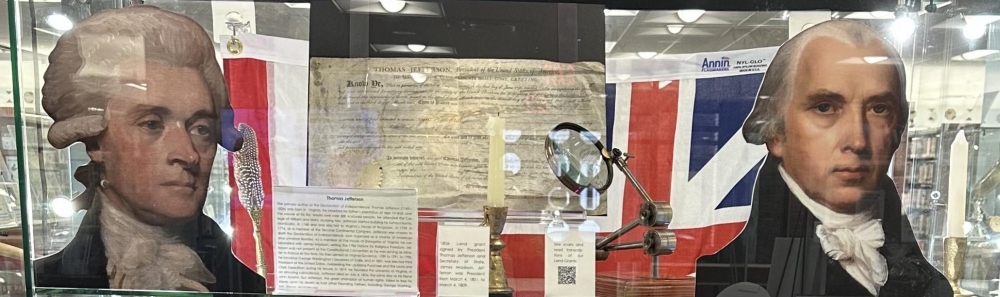
On the first shelf, we encounter the first piece of the archival heart of this exhibit, a vintage land grant personally signed by President Thomas Jefferson and his Secretary of State James Madison, on vellum. These were used to pay wages for soldiers from the Revolutionary War.
Look through the magnifying glass to see these amazing signatures by the primary author of the Declaration of Independence and the "Father of the Constitution." These were arguably the two essential minds who shaped the American Republic.
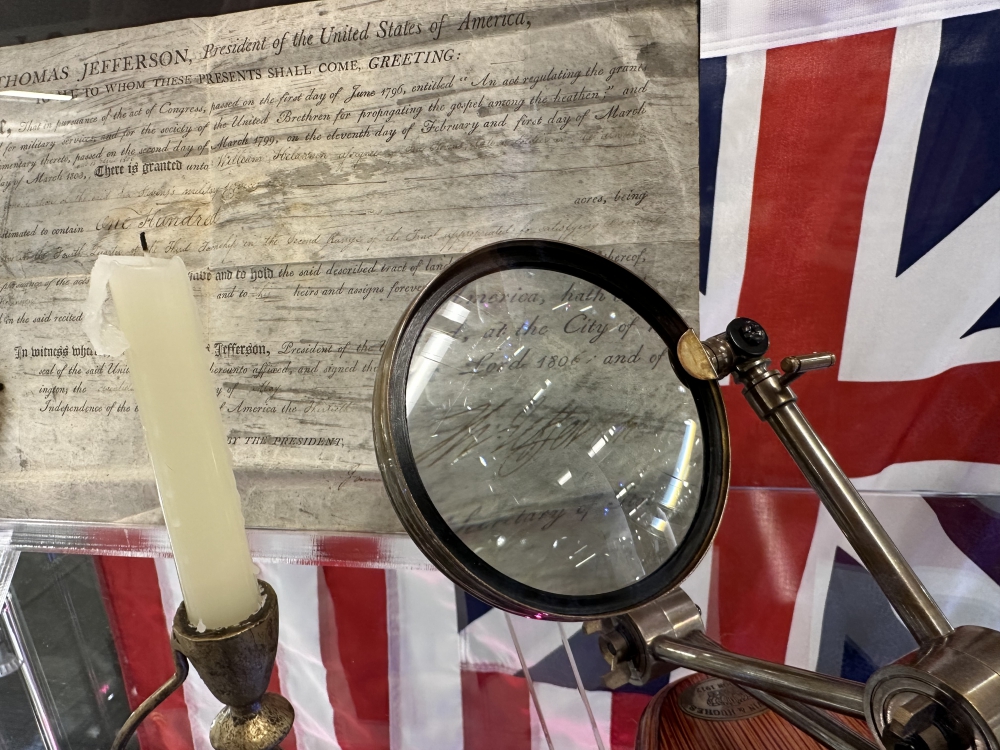
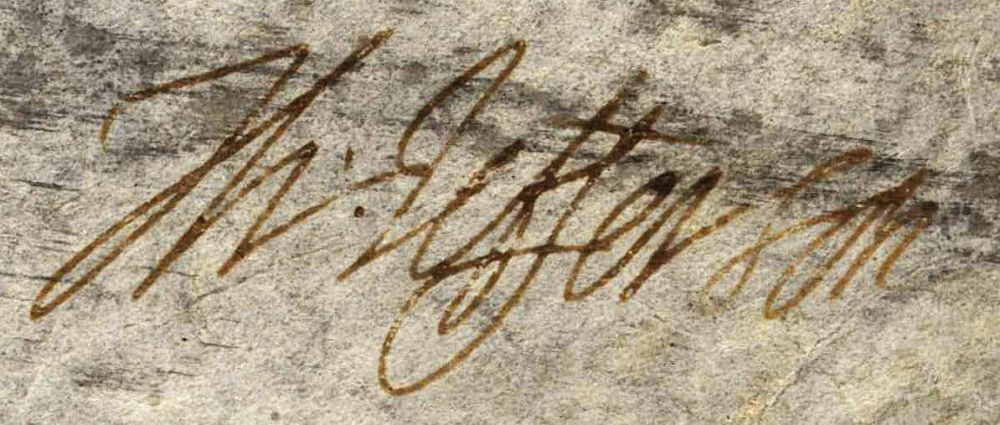
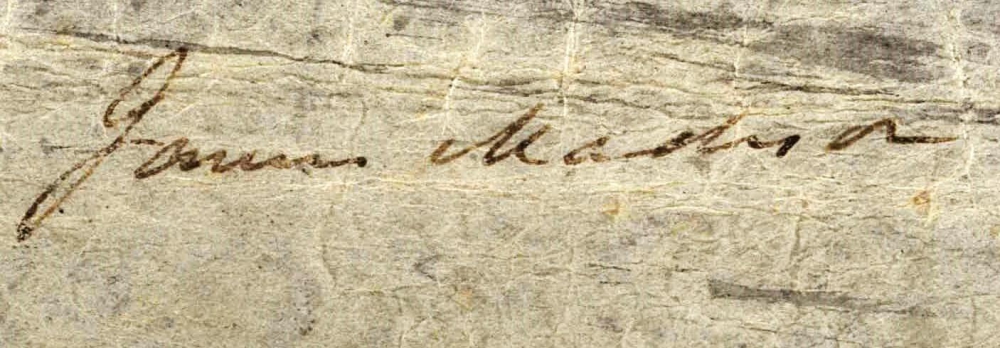
READ MORE and SEE SCANS & Transcriptions of our LAND GRANTS
Thomas Jefferson Bio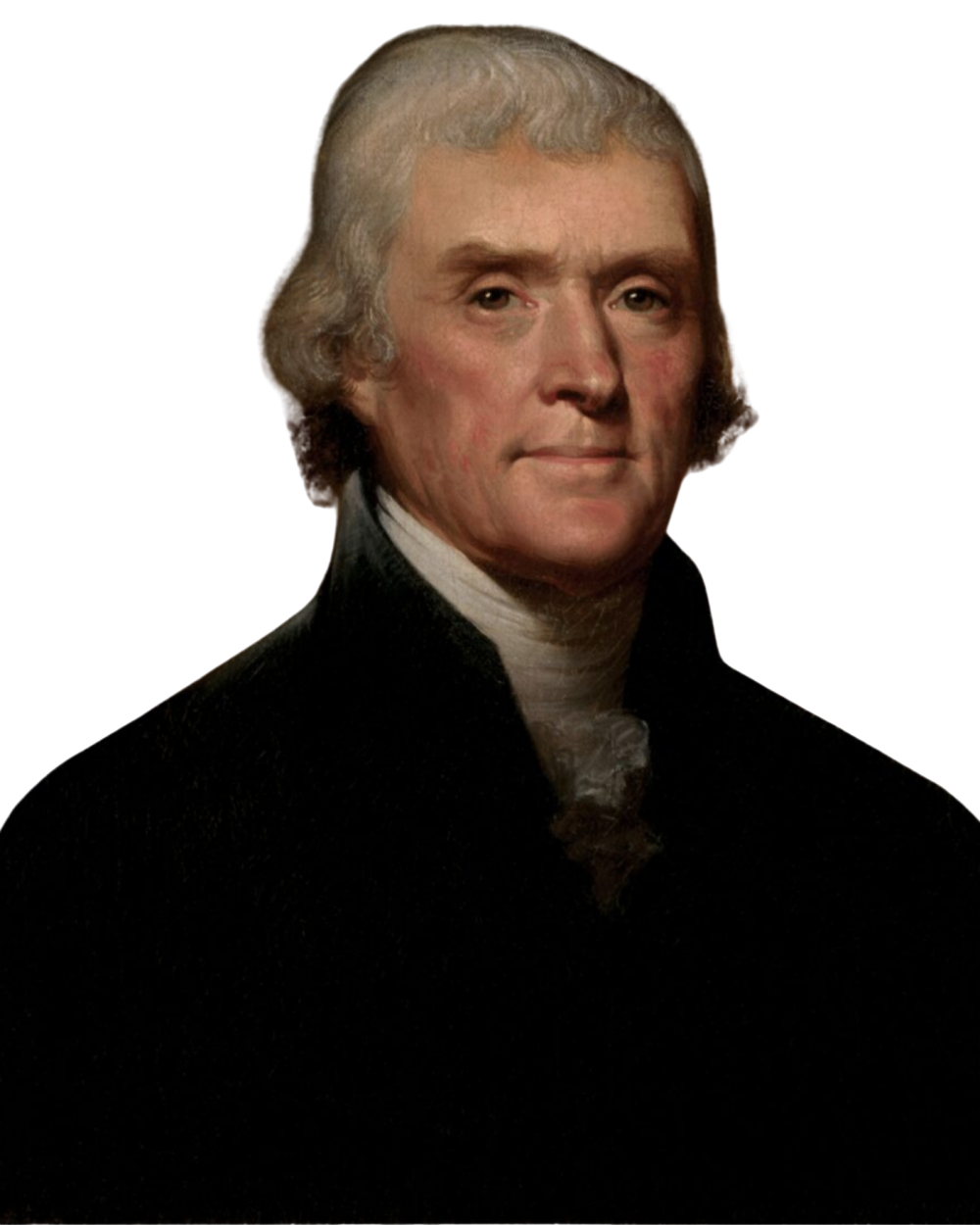 The primary author of the Declaration of Independence, Thomas Jefferson (1743—1826) was born in Virginia. He inherited his father’s plantation at age 14 and, over the course of his life, would own over 600 enslaved people. He attended the College of William and Mary, studying law. Jefferson started building his famous home, Monticello, in 1768 and was elected to Virginia’s House of Burgesses in 1769. In 1776, as a member of the Second Continental Congress, Jefferson was chosen to draft the Declaration of Independence, now regarded as a charter of American and universal liberties. As a member of the House of Delegates of Virginia, he collaborated with James Madison, writing the 1786 Statute for Religious Freedom. Jefferson was not present at the Constitutional Convention as he was serving as Minister to France at the time. He then served as Virginia Governor, 1789 to 1791. In 1790, he became George Washington’s Secretary of State, and in 1801, was elected third President of the United States, overseeing the Louisiana Purchase and the Lewis and Clark Expedition during his tenure. In 1819, he founded the University of Virginia. In an amazing coincidence, Jefferson died on July 4, 1826, the same day as his friend John Adams. But Jefferson, the great champion of human rights, failed to free his slaves upon his death as had other Founding Fathers, including George Washington. SOURCE
James Madison Bio
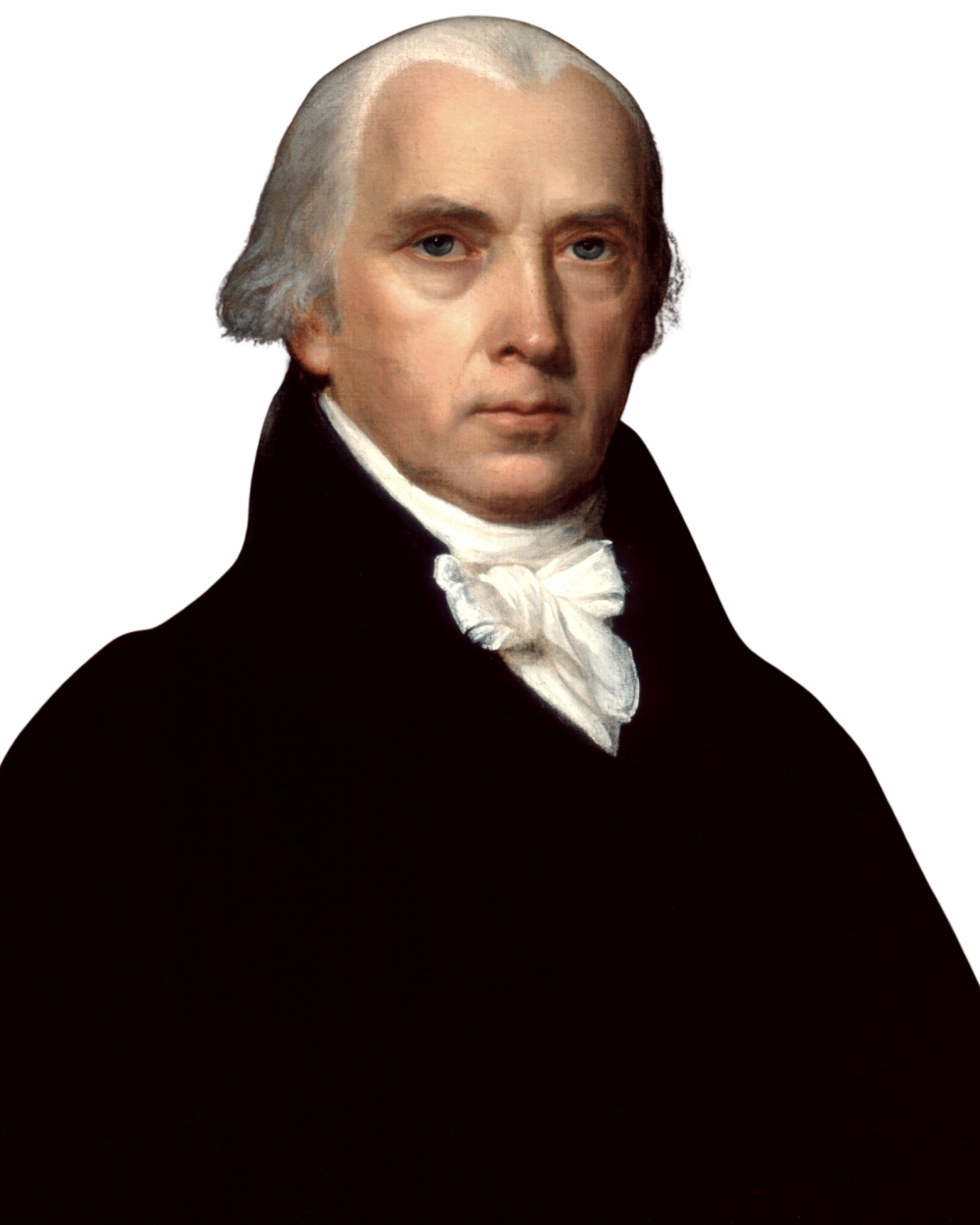 James Madison (1751 - 1836) is known as the “Father of the Constitution.” He was born in 1751, to a wealthy Virginia planter and graduated Princeton University. Elected to the Virginia legislature in 1776, he worked closely with Thomas Jefferson. He served in the Continental Congress, 1780-83, and in preparation for the Constitutional Convention of 1787, drafted the Virginia Plan, which would serve as the framework of the Constitution. In it, he proposed a radical new idea: a central government with three branches that would check and balance each other, keeping any one from wielding too much power. Along with Alexander Hamilton and John Jay, Madison contributed to the Federalist Papers, an argument for the ratification of the Constitution. Realizing that ratification could only be achieved with the promise of a Bill of Rights, Madison compiled a list of 19 proposals, 10 of which would go on to be ratified by the states. Seven years after marrying Dolley Payne Todd in 1794, Madison inherited his father’s estate, Montpelier, and the 100-plus enslaved African Americans who came with it. Also in 1801, President Thomas Jefferson made Madison his Secretary of State. Madison was elected the 4th President in 1809. He died at Montpelier in 1836. The author of the Bill of Rights did not free his slaves. SOURCE
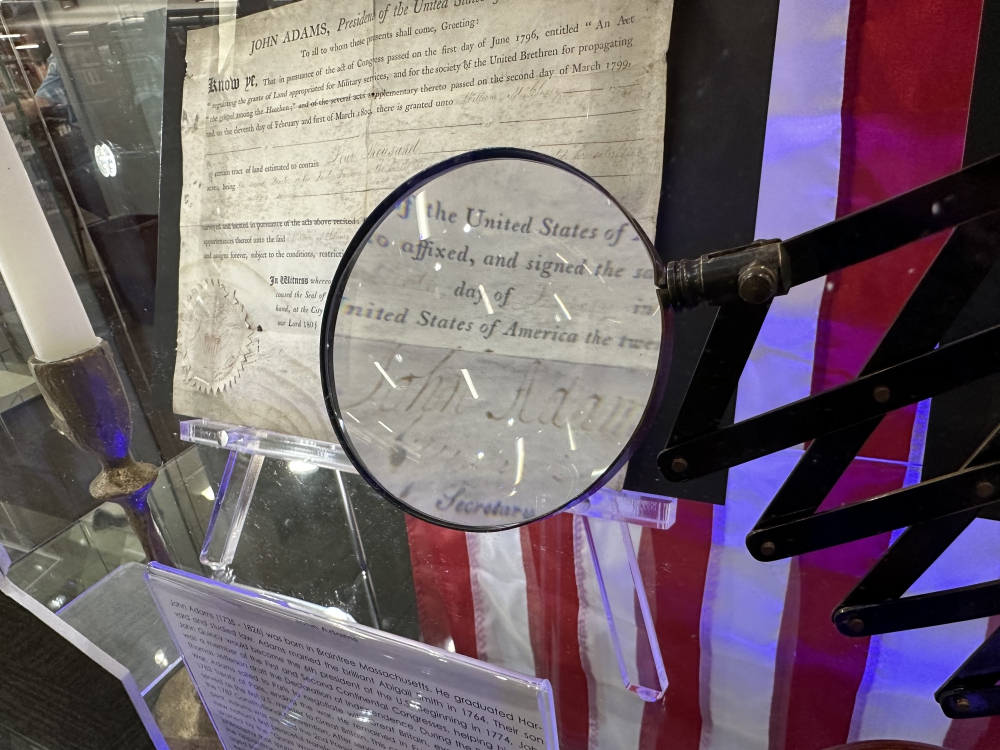
1801 Land Grant Signed by John Adams and John Marshall
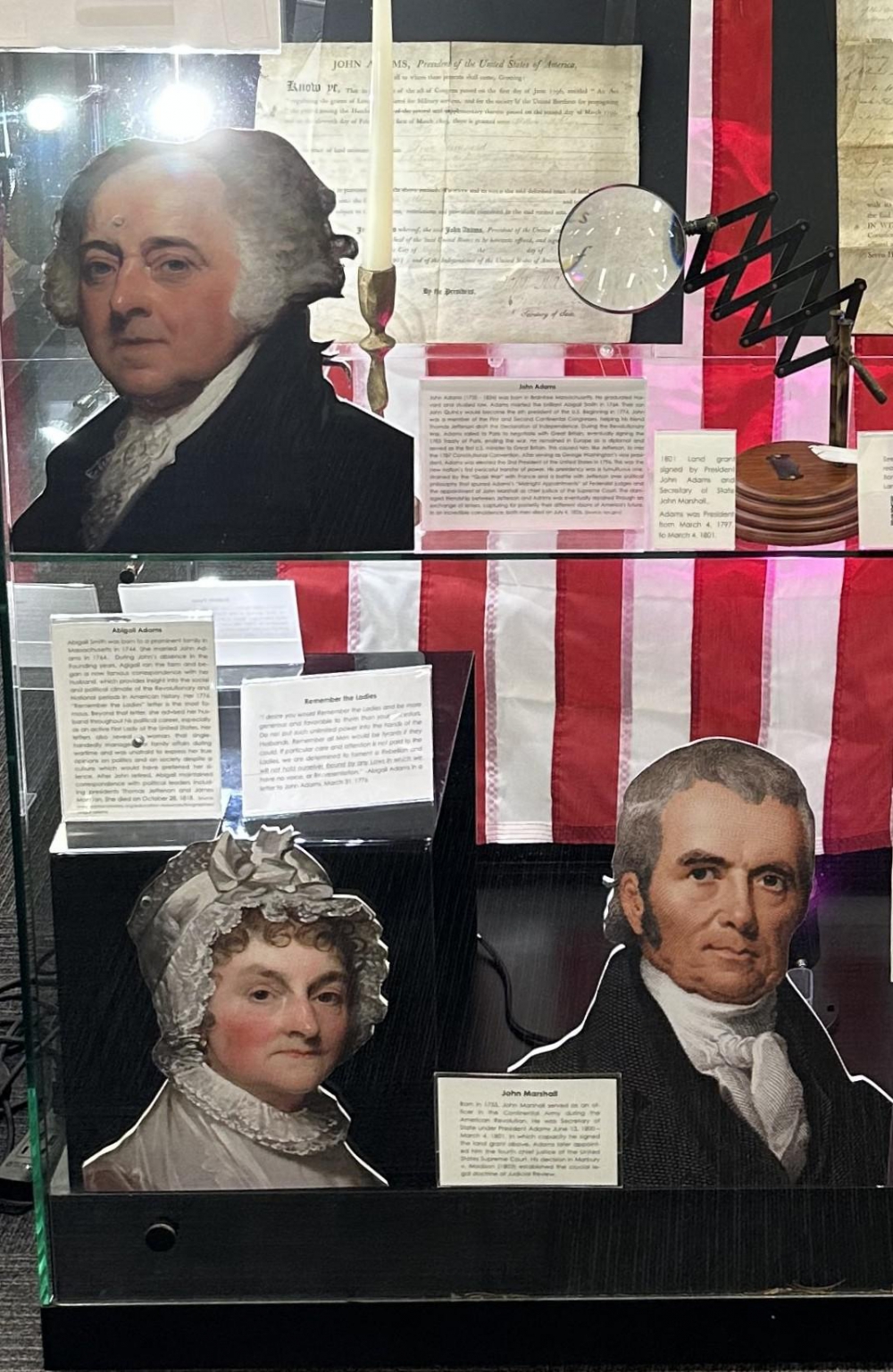 On the next shelf is a land grant signed by President John Adams and his Secretary of State (and future Chief Justice of the Supreme Court), John Marshall.
A look through the magnifying glass allows you to travel through time and to imagine John Adams himself sitting at his desk to sign this doument.
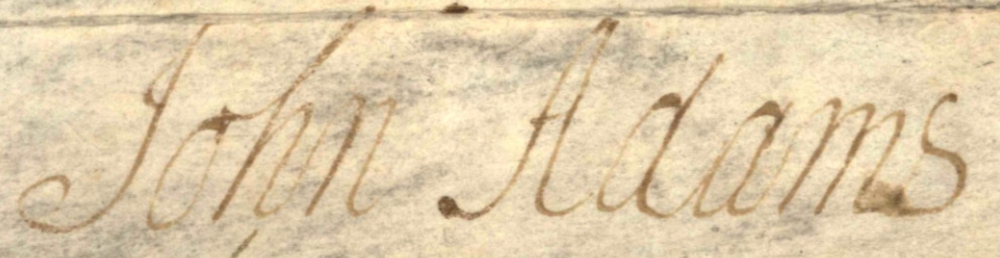

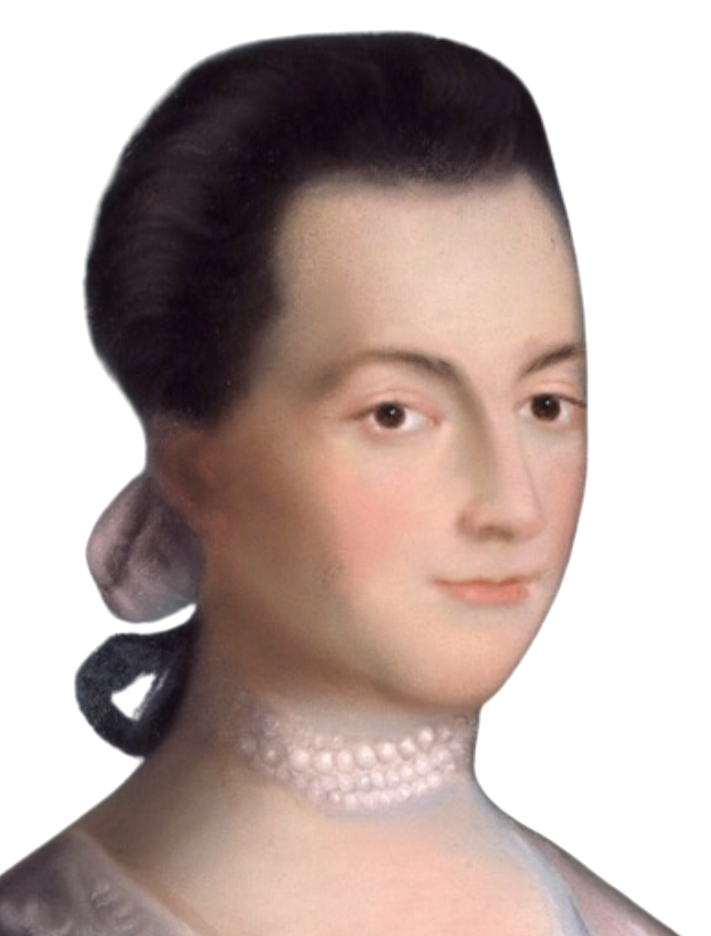 Also pictured is John's wife, Abigail Adams, an important Founding Woman. She was born to a prominent family in Massachusetts in 1744 and married John Adams in 1764. During John’s absence in the Founding years, Agigail ran the farm and began a now famous correspondence with her husband, which provides insight into the social and political climate of the Revolutionary and National periods in American history. Her 1776 “Remember the Ladies” letter is the most famous. Beyond that letter, she advised her husband throughout his political career, especially as an active First Lady of the United States. Her letters also reveal a woman that single-handedly managed her family affairs during wartime and was unafraid to express her true opinions on politics and on society despite a culture which would have preferred her silence. After John retired, Abigail maintained correspondence with political leaders including presidents Thomas Jefferson and James Madison. She died on October 28, 1818. SOURCE
Remember the Ladies
“I desire you would Remember the Ladies and be more generous and favorable to them than your ancestors. Do not put such unlimited power into the hands of the Husbands. Remember all Men would be tyrants if they could. If particular care and attention is not paid to the Ladies, we are determined to foment a Rebellion and will not hold ourselves bound by any Laws in which we have no voice, or Representation.” ~Abigail Adams in a letter to John Adams, March 31, 1776
John Adams Bio
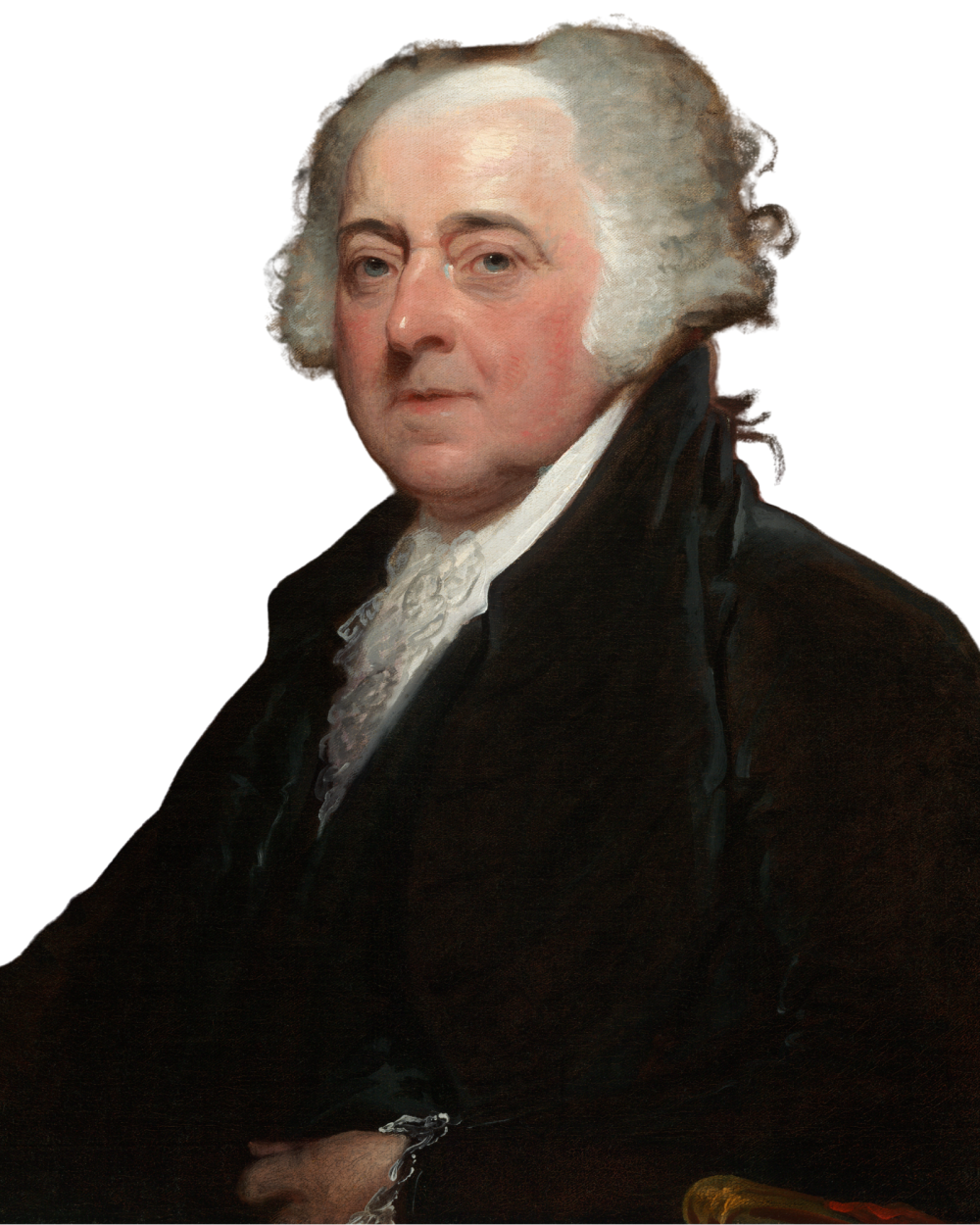 John Adams (1735 - 1826) was born in Braintree Massachusetts. He graduated Harvard and studied law. Adams married the brilliant Abigail Smith in 1764. Their son John Quincy would become the 6th president of the U.S. Beginning in 1774, John was a member of the First and Second Continental Congresses, helping his friend Thomas Jefferson draft the Declaration of Independence. During the Revolutionary War, Adams sailed to Paris to negotiate with Great Britain, eventually signing the 1783 Treaty of Paris, ending the war. He remained in Europe as a diplomat and served as the first U.S. minister to Great Britain. This caused him, like Jefferson, to miss the 1787 Constitutional Convention. After serving as George Washington’s vice president, Adams was elected the 2nd President of the United States in 1796. This was the new nation’s first peaceful transfer of power. His presidency was a tumultuous one, strained by the “Quasi War” with France and a battle with Jefferson over political philosophy that spurred Adams’s “Midnight Appointments” of Federalist judges and the appointment of John Marshall as chief justice of the Supreme Court. The damaged friendship between Jefferson and Adams was eventually repaired through an exchange of letters, capturing for posterity their different visions of America's future. In an incredible coincidence, both men died on July 4, 1826. SOURCE
John Marshall Bio
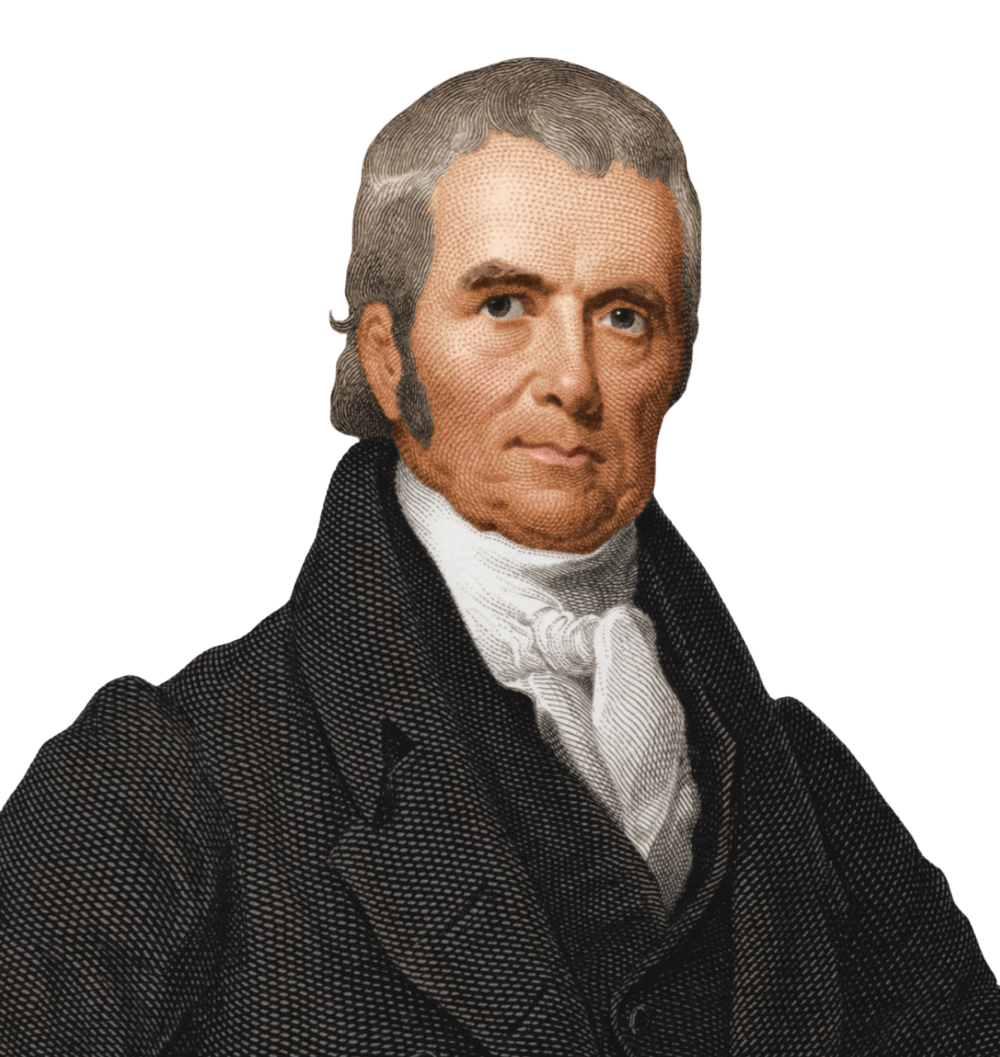 John Marshall was born in Virginia in 1755. When the Revolutionary War began, John served in the Virginia Continental Regiment, eventually achieving the rank of captain. Future President General George Washington admired John and appointed him Judge Advocate General of the Continental Army before he had any legal training. When his service ended in 1780, Marshall began his legal studies at the College of William and Mary. He served on the Virginia delegation that ratified the new Constitution in 1788. He served as Secretary of State under President John Adams. President Adams later nominated Marshall to the Supreme Court, where he oversaw the landmark case Marbury v. Madison (1803). As Chief Justice, John wrote a masterful opinion that affirmed the Supreme Court’s power of judicial review, which established that the fledgling Supreme Court had the authority to interpret the words in the Constitution. His Marbury v. Madison opinion also reinforced “rule of law” by saying that no one is above the law, including the President and the Cabinet. By the 1830s, Marshall and his five sons had acquired several large farms; approximately 250 enslaved persons worked on their plantations. John Marshall died on July 6, 1835. SOURCE
1784 Land Grant Signed by Virginia Governor Patrick Henry
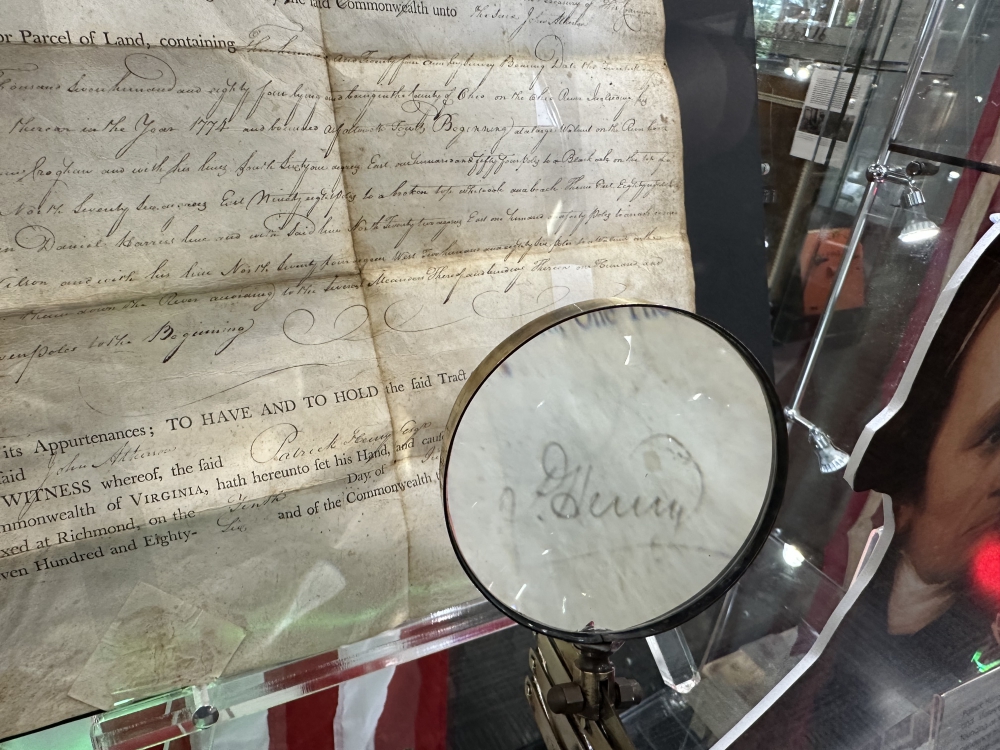
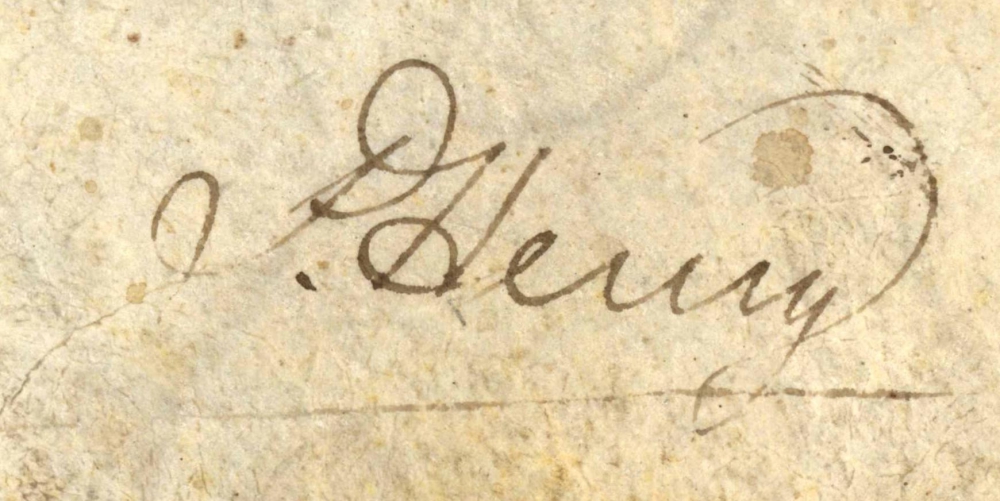
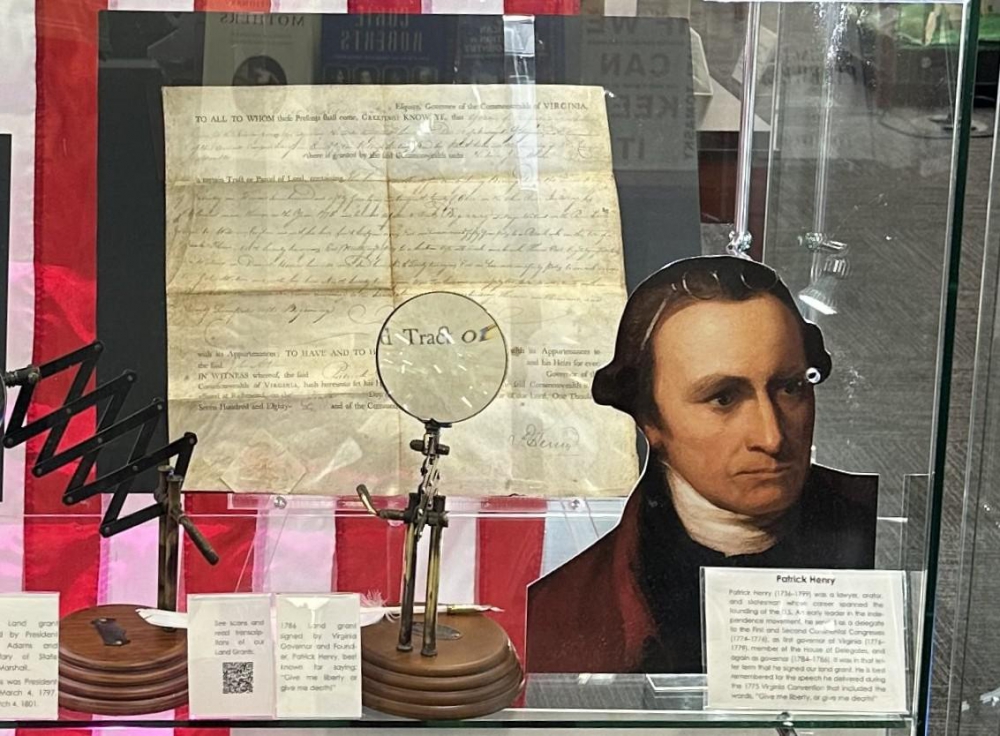 To the right on the second shelf is a different kind of land grant signed bythe fiery Founder and then Governor of Virginia, Patrick Henry. This grant is a conveyance of land, not military pay, but it holds a lot of interest both for the interesting use of trees to mark boundaries, and the famous man who signed it.
Patrick Henry (1736–1799) was a lawyer, orator, and statesman whose career spanned the founding of the U.S. An early leader in the inde-pendence movement, he served as a delegate to the First and Second Continental Congresses (1774–1776), as first governor of Virginia (1776–1779), member of the House of Delegates, and again as governor (1784–1786). It was in that letter term that he signed our land grant. He is best remembered for the speech he delivered during the 1775 Virginia Convention that included the words, “Give me liberty, or give me death!”
The Gnadenhutten Massacre
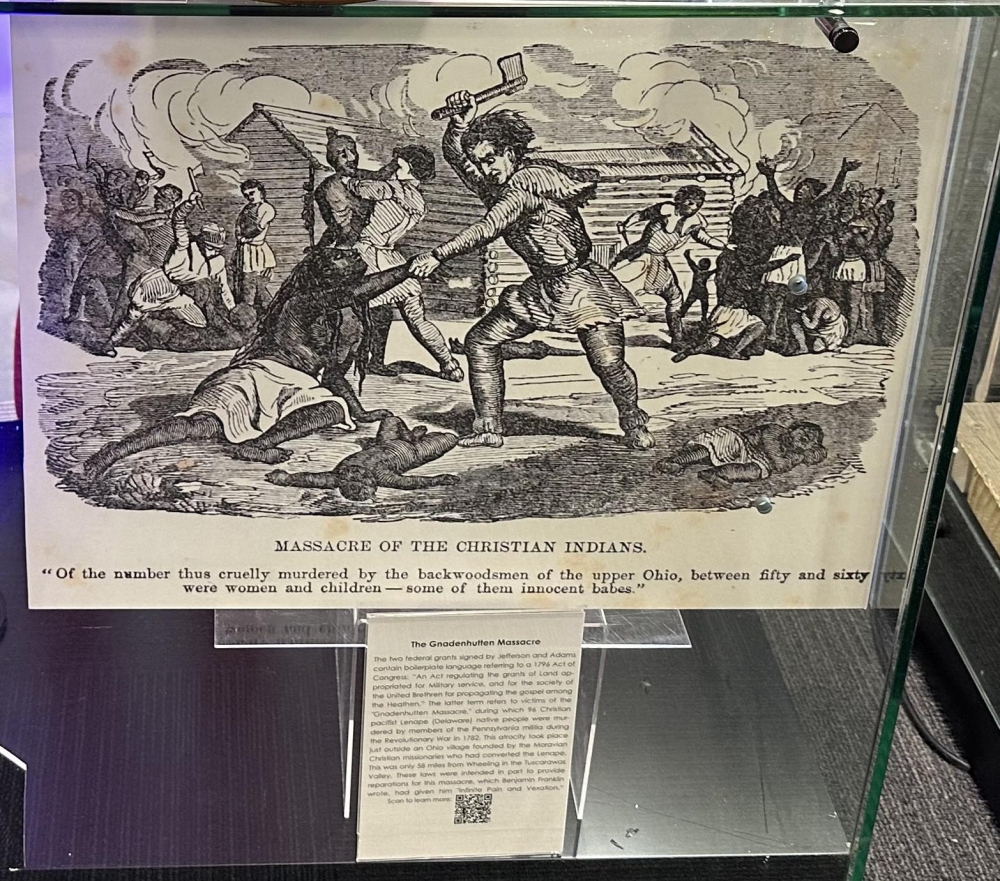 At the bottom right of this case, we learn about a surprising incident recalled by the land grants texts.
The two federal grants signed by Jefferson and Adams contain boilerplate language referring to 1796 & 1800 Acts of Congress: “An Act regulating the grants of Land appropriated for Military service, and for the society of the United Brethren for propagating the gospel among the Heathen.” The latter term refers indirectly to victims of the "Gnadenhutten Massacre," during which 96 Christian pacifist Lenape (Delaware) native people were murdered by members of the Pennsylvania militia during the Revolutionary War in 1782. This atrocity took place just outside an Ohio village founded by the Moravian Christian missionaries who had converted the Lenape. This was only 58 miles from Wheeling in the Tuscarawas Valley. These laws were intended in part to provide reparations for this massacre, which Benjamin Franklin wrote, had given him "infinite Pain and Vexation." SOURCE
 The "Betsy Ross Flag"
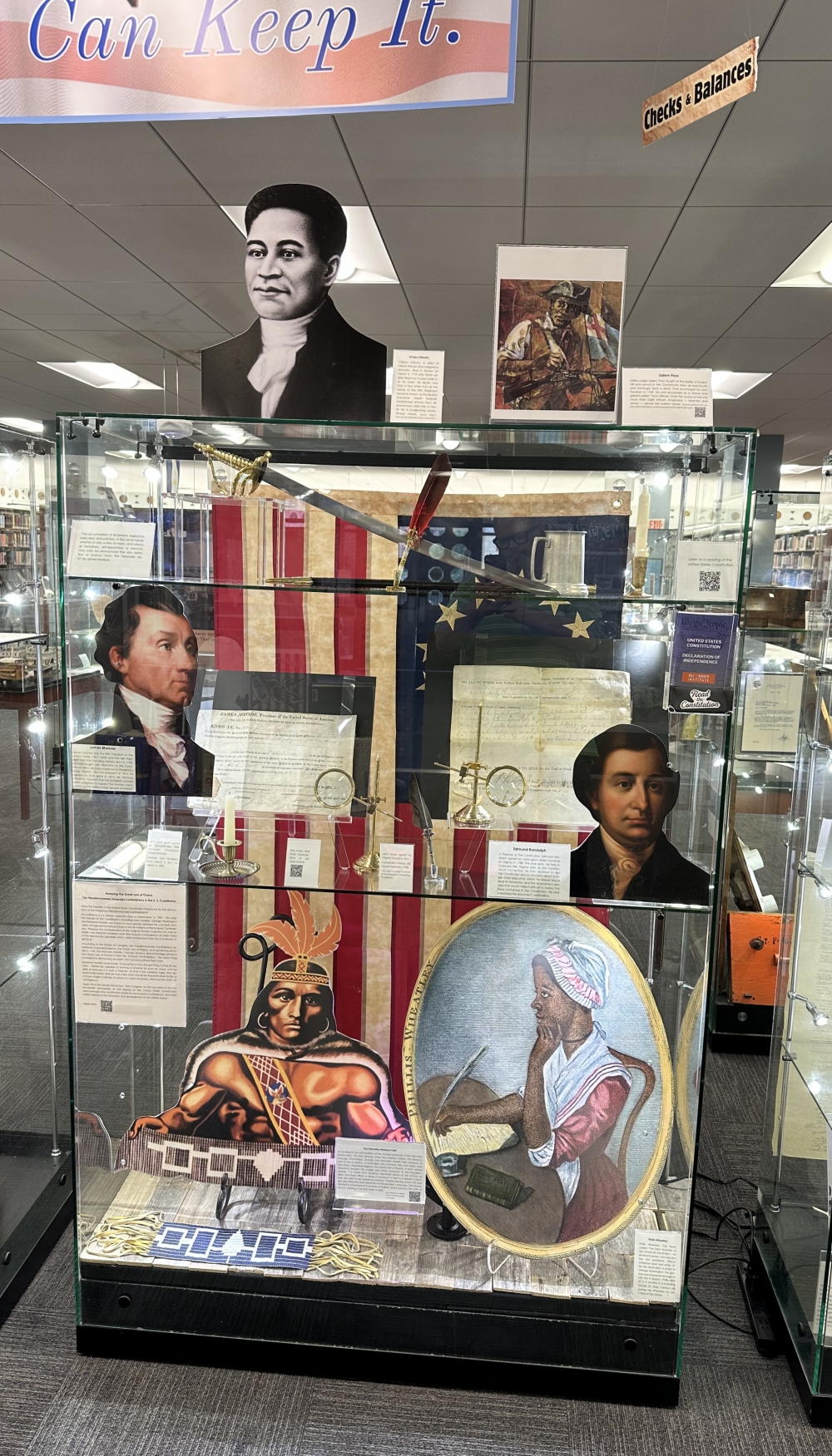
The background of the second large display case is formed by a more familiar American flag. On June 14, 1777, the Continental Congress passed the Flag Resolution: "Resolved, That the flag of the United States be thir-teen stripes, alternate red and white; that the union be thirteen stars, white in a blue field, repre-senting a new constellation." According to legend, Betsy Ross sewed the first such flag, with the stars in a circle, at the behest of George Washington.
African Americans in the American Revolution
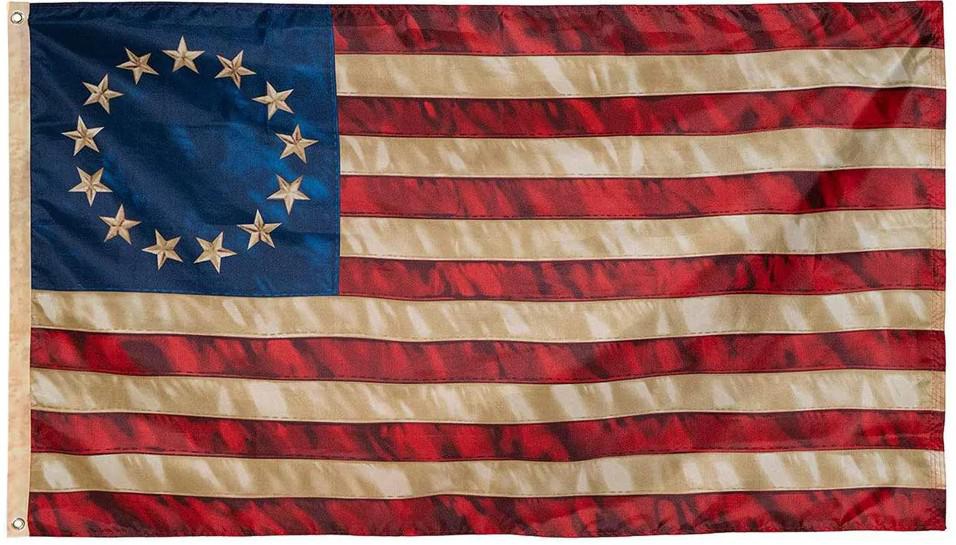
Atop the second large display case is a tribute to African American participants in the American Revolution.
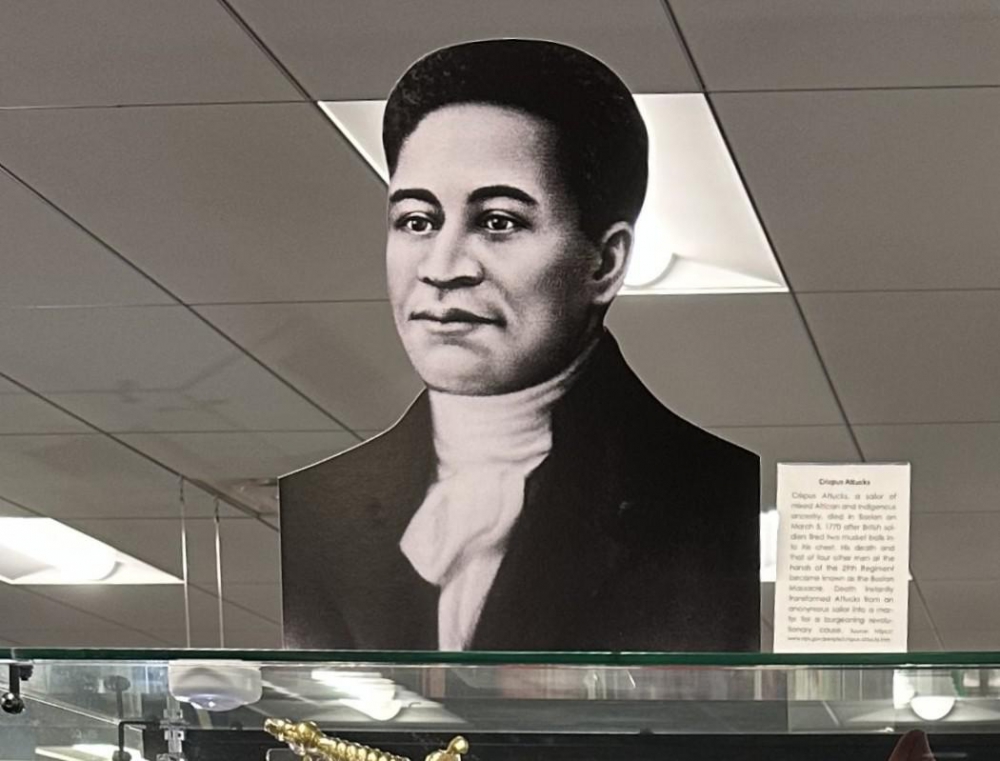
 First up is Crispus Attucks, who, in 1770, became the first casualty of the American Revolution when he was shot and killed in what became known as the Boston Massacre. Although Attucks was credited as the leader and instigator of the event, debate raged for over as century as to whether he was a hero and a patriot, or a rabble-rousing villain. John Adams himself defended the British soldiers at trial. The debate notwithstanding, Attucks, immortalized as "the first to defy, the first to die," has been lauded as a true martyr, "the first to pour out his blood as a precious libation on the altar of a people's rights." SOURCE
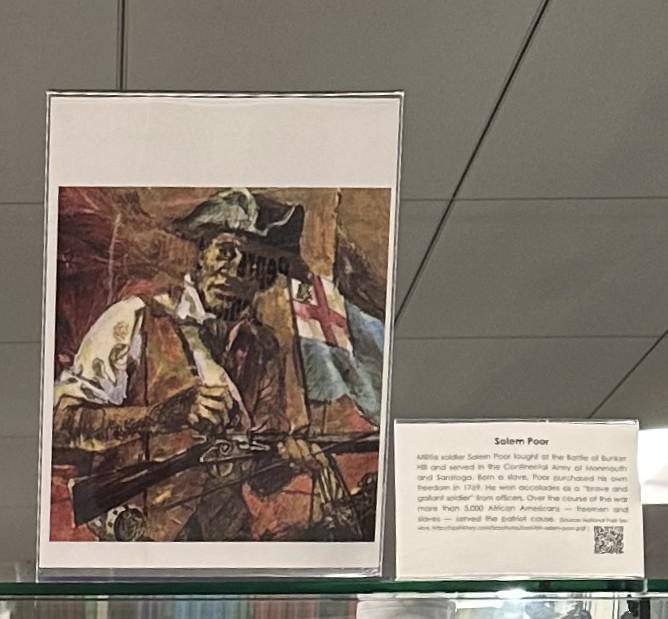
To the right of Attucks, we learn of Salem Poor, a militia soldier Salem who fought at the Battle of Bunker Hill and served in the Continental Army at Monmouth and Saratoga. Born a slave, Poor purchased his own freedom in 1769. He won accolades as a “brave and gallant soldier” from officers. Over the course of the war more than 5,000 African Americans — freemen and slaves — served the patriot cause. SOURCE
Land Grants Signed by James Monroe and Edmund Randolph
Beneath Attucks and Poor, we find two more land grants.
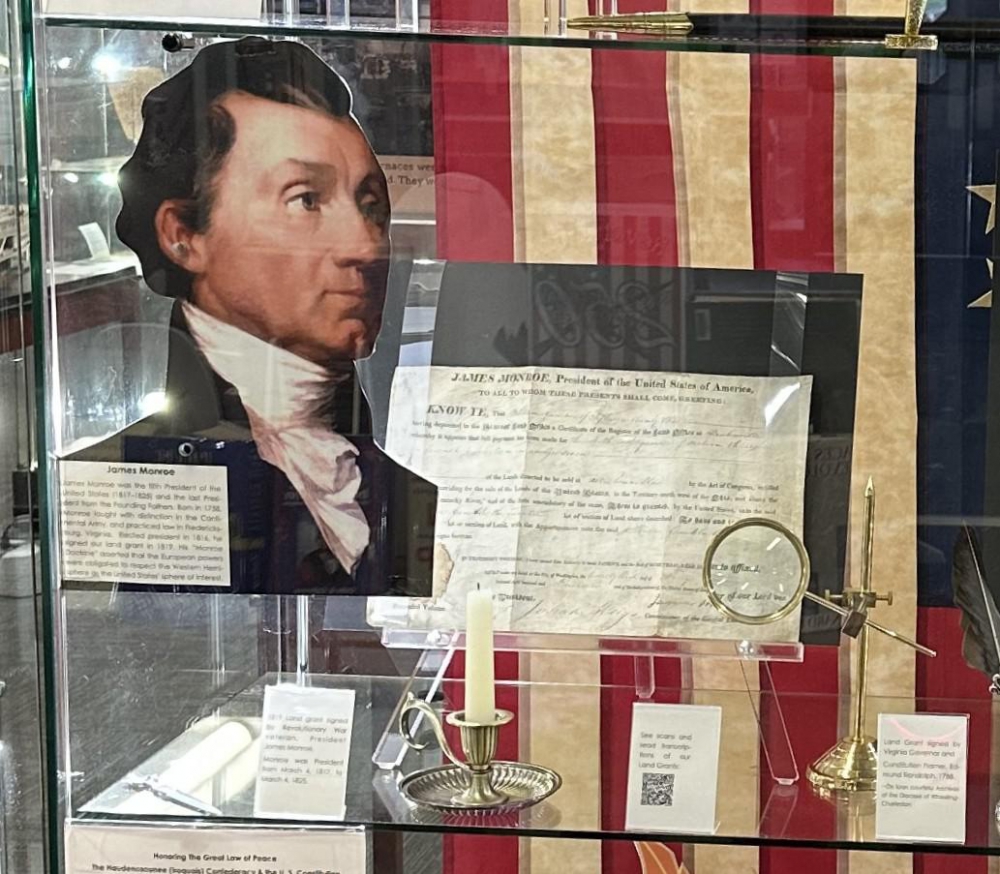 The first, from 1819, is signed by President James Monroe, the fifth President of the United States (1817–1825) and the last President from the Founding Fathers. Born in 1758, Monroe fought with distinction in the Continental Army, and practiced law in Fredericksburg, Virginia. Elected president in 1816, his “Monroe Doctrine” asserted that the European powers were obligated to respect the Western Hemisphere as the United States' sphere of interest.
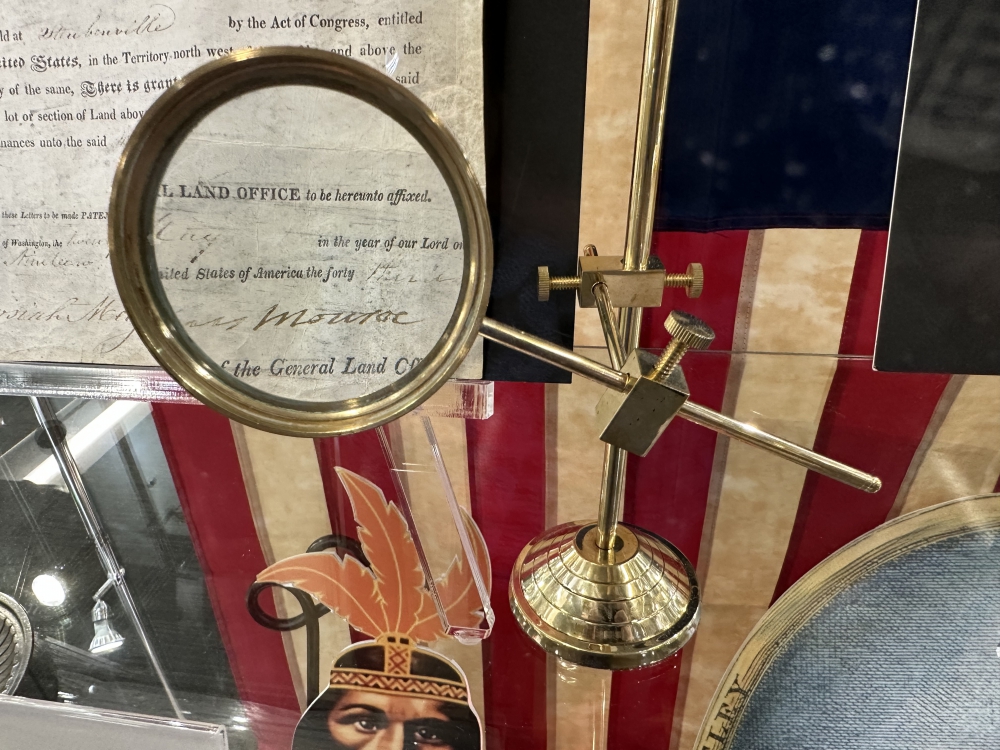

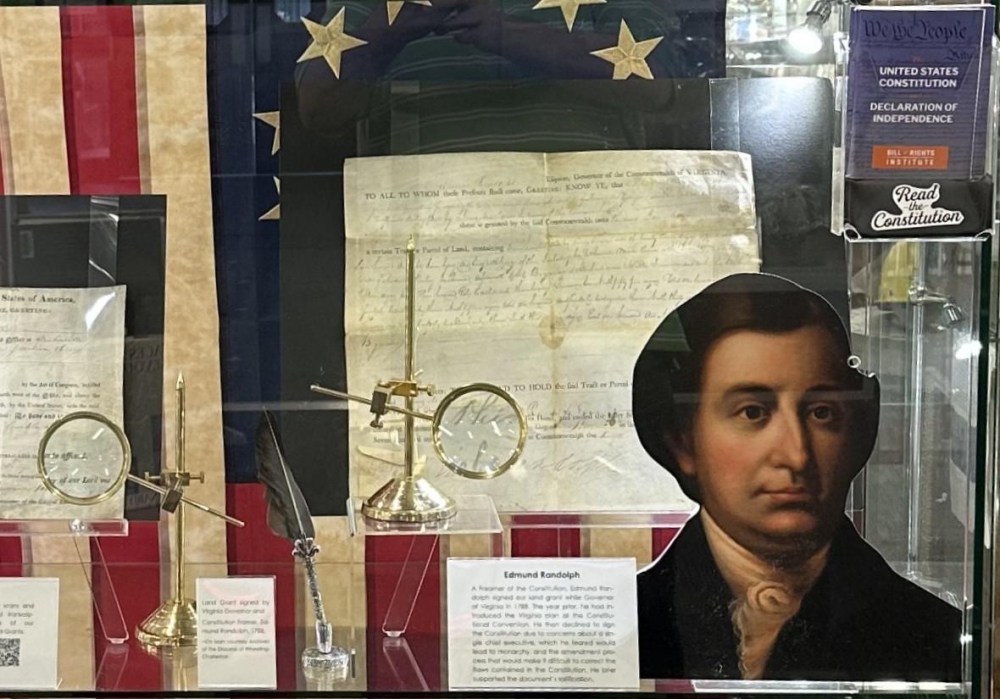 The final land grant is signed by Edmund Randolph. A Framer of the Constitution, Edmund Randolph signed our land grant while Governor of Virginia in 1788. The year prior, he had introduced the Virginia Plan at the Constitutional Convention. He then declined to sign the Constitution due to concerns about a single chief executive, which he feared would lead to monarchy, and the amendment process that would make it difficult to correct the flaws contained in the Constitution. He later supported the document’s ratification.
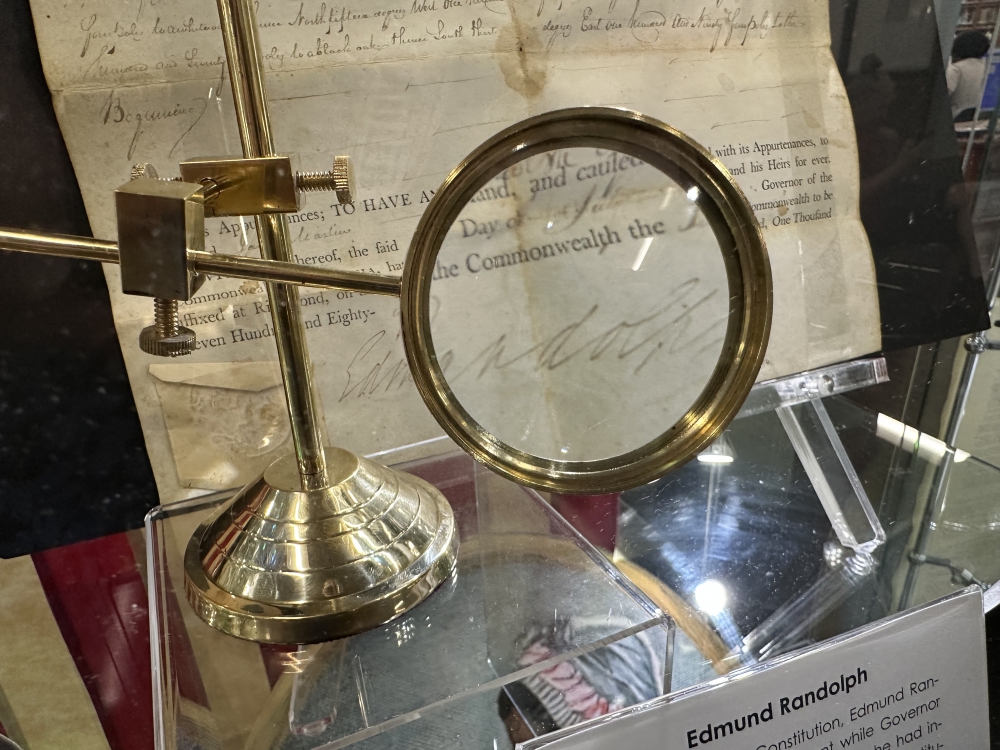
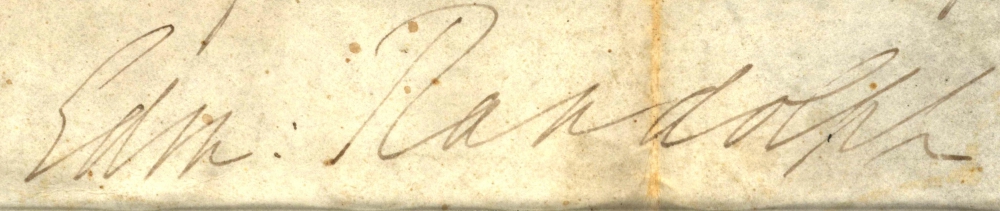
This document is on loan from the Archives of the Diocese of Wheeling-Charleston.
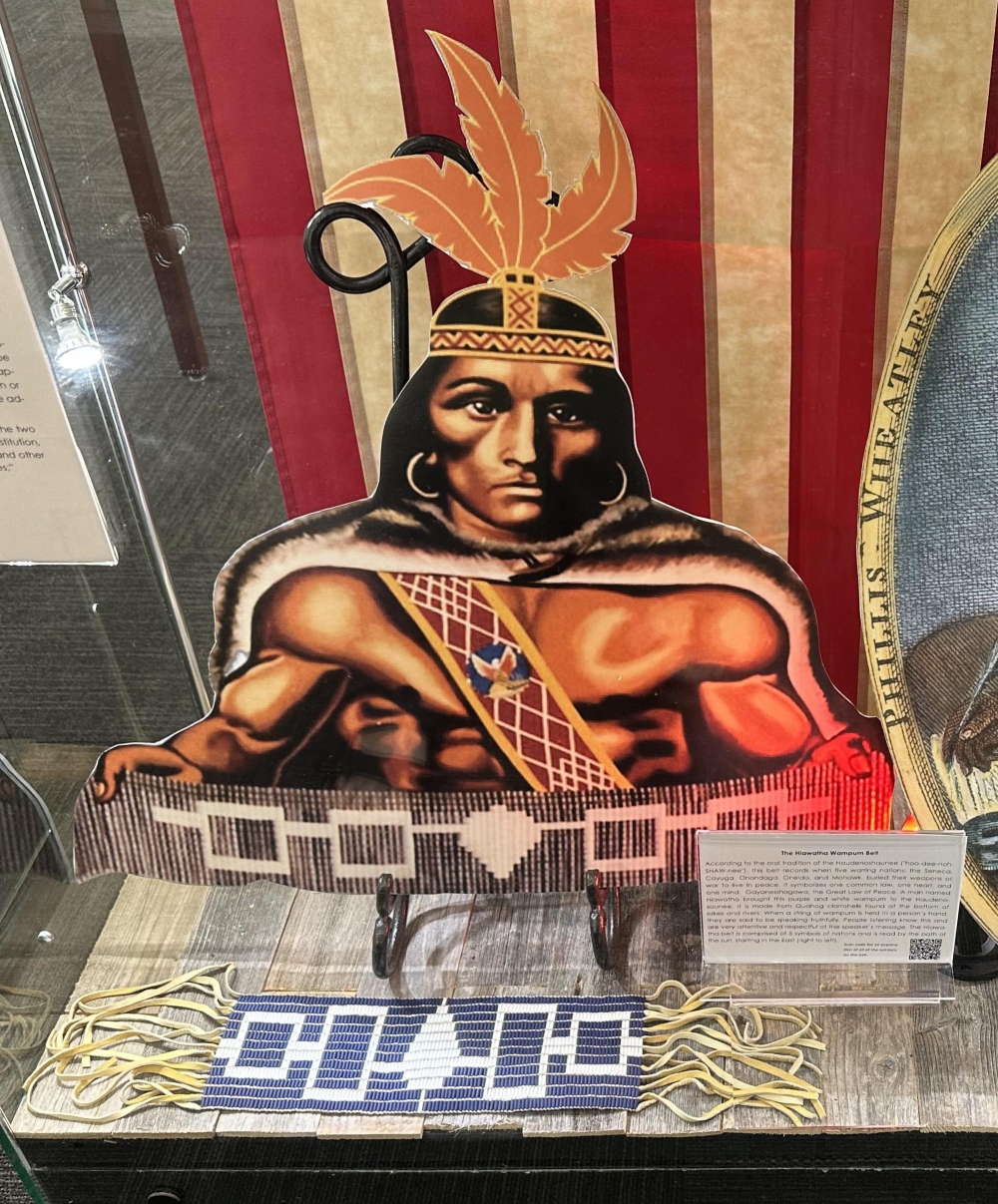 Honoring The Great Law of Peace -- The Haudenosaunee (Iroquois) Confederacy & the U. S. Constitution
On the left, at the bottom of this case, we find an image of the great Hiawatha, and a replica of his highly symbolic wampum belt.
Were the Framers of the United States Constitution influenced by the democracy of the Indigenous Haudenosaunee Confederacy?
According to a U.S. Senate resolution read on September 16, 1987, “the original framers of the Constitution, including most notably, George Washington and Benjamin Franklin, are known to have greatly admired the concepts, principles and governmental practices of the Six Nations of the Iroquois Confederacy. Whereas the confederation of the original Thirteen Colonies into one republic was explicitly modeled upon the Iroquois Confederacy as were many of the democratic principles which were incorporated into the Constitution itself (3-4).”
According to the Library of Congress, the Haudenosaunee Confederacy established Gayanesshagowa, the Great Law of Peace, as its governing principle in 1142. The Mohawk, Oneida, Cayuga, Seneca, and Onondaga joined in the Great Law of Peace to form the “Iroquois Confederacy,” the oldest living participatory democracy on earth. The Tuscarora joined them later.
Benjamin Franklin once wrote: “It would be a very strange Thing, if [the] Six Nations… should be capable of forming a Scheme for such an Union, and be able to execute it in such a Manner, as that it has subsisted Ages, and appears indissoluble; and yet that a like Union should be impracticable for ten or a Dozen English Colonies, to whom it is more necessary, and must be more advantageous.”
Again from the Senate Resolution: “the Congress, on the occasion of the two hundredth anniversary of the signing of the United States Constitution, acknowledges the contribution made by the Iroquois Confederacy and other Indian Nations to the formation and development of the United States.” SOURCE
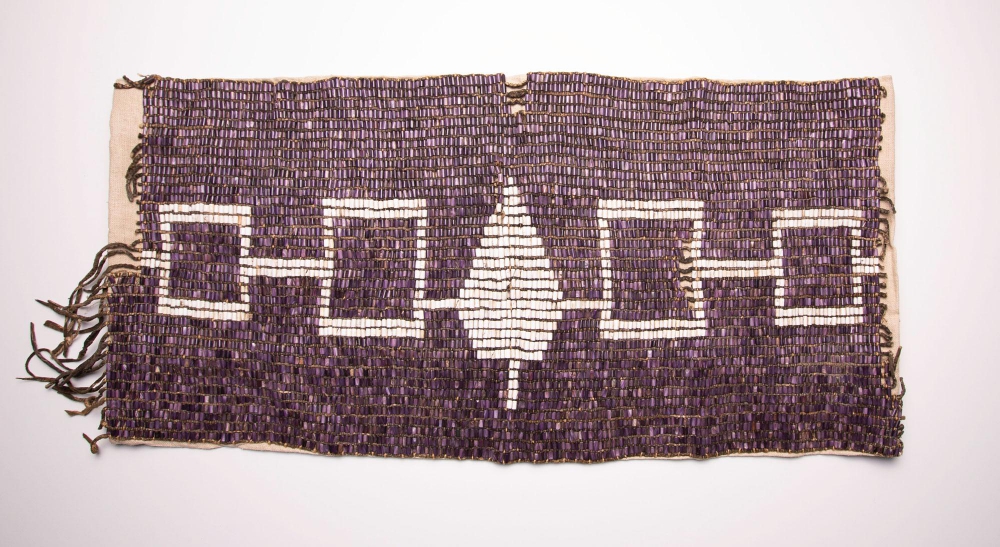
The Hiawatha Wampum Belt
According to the oral tradition of the Haudenoshaunee ("hoo-dee-nah-SHAW-nee"), this belt records when five warring nations: the Seneca, Cayuga, Onondaga, Oneida, and Mohawk, buried their weapons of war to live in peace.It symbolizes one common law, one heart, and one mind. Gayanashagowa, the Great Law of Peace (Mohawk: Kaianere'kó:wa). A man named Haiwatha brought this purple and white wampum to the Haudenoshaunee. It is made from Quahog clam shells found at the bottoms of lakes and rivers. When a string of wampum is held in a parson's hands, they are understood to be speaking truthfully. People listening know this and are very respectful of the speaker's message. The Hiawatha belt is comprised of symbols of the 5 nations and is read by the path of the sun, starting in the east (right to left). SOURCE
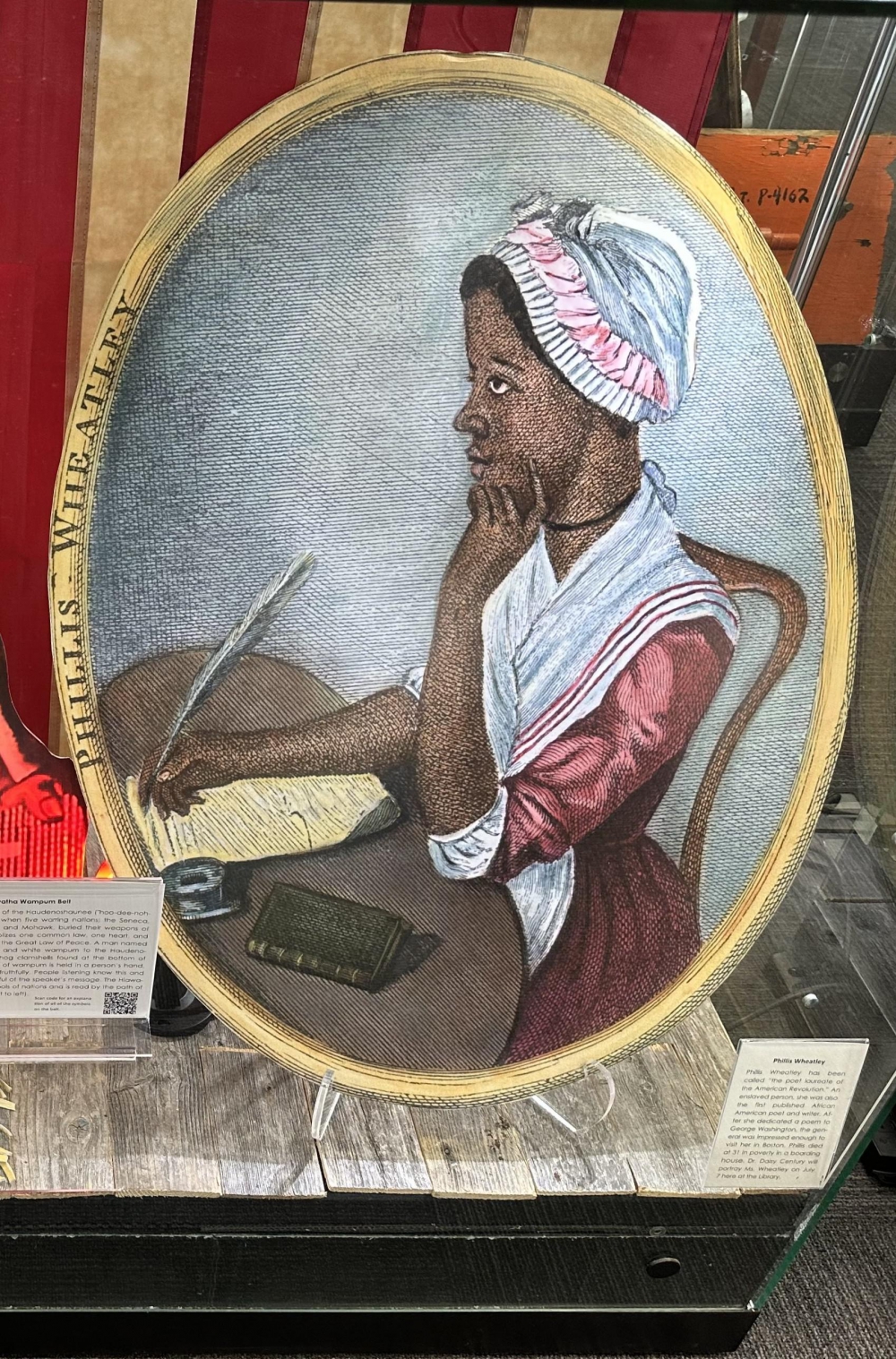 Phillis Wheatley
To the right of Hiawatha is a large portrait of the Poet Laureate of the American Revolution."
An enslaved person, Wheatley was also the first published African American poet and writer. After she dedicated a poem to George Washington, the general was impressed enough to visit her in Boston.
Don't forget to look up!
At this end of the exhibit, you will see some of the best ideas of the Framers of the Constitution, inluding concepts like the separation of powers, popular sovreignty. and fundamental rights.
 Hear a reading of the US Constitution and Bill of Rights.
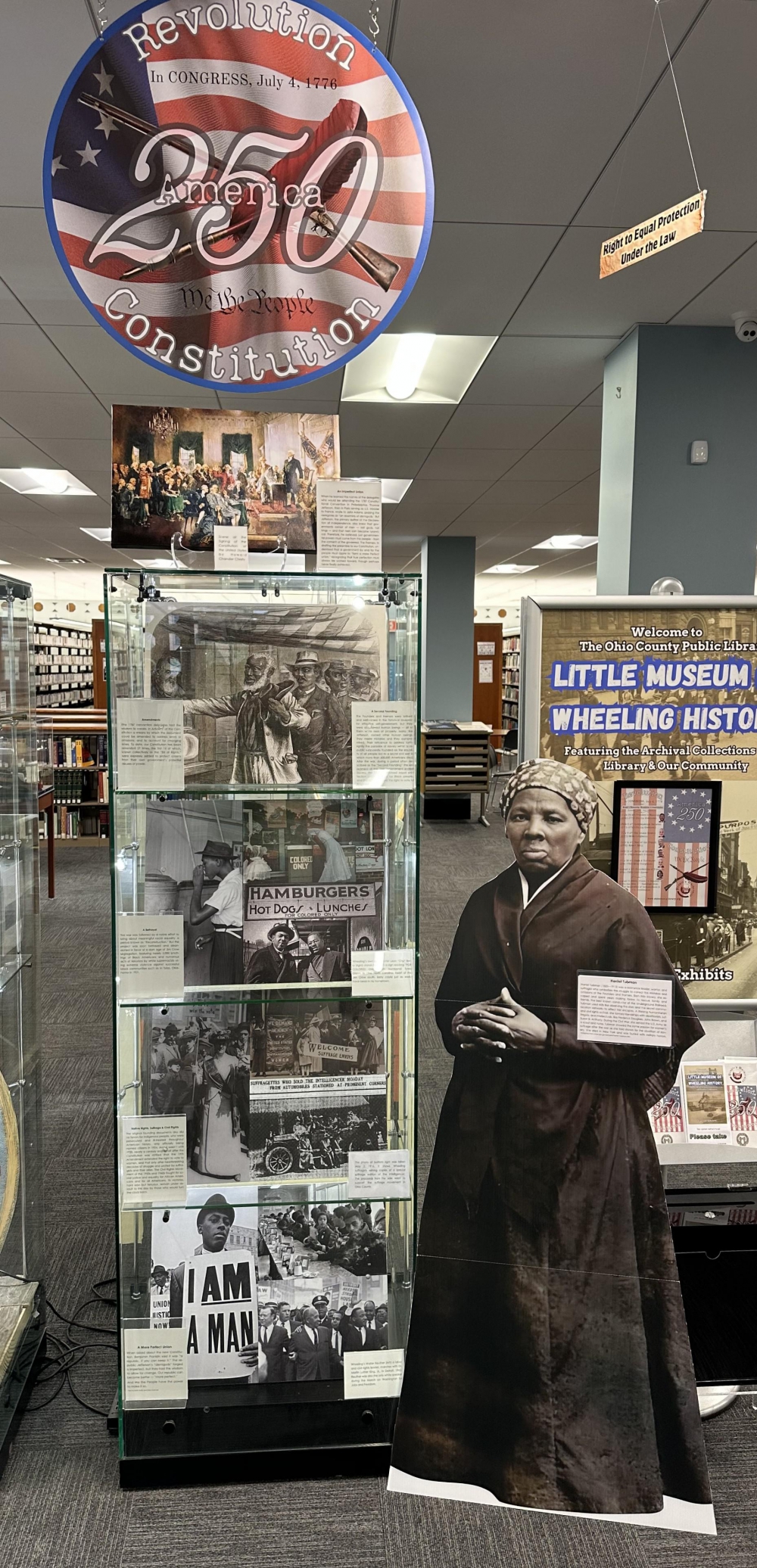
The final display case at the right of the exhibit is perhaps the most important.
It contains an analysis of the successes and failures of the Founders and Framers, and a look at the work of those heroes who have worked to preserve our republic, expanding its reach and securing its survival.
Standing opposite Ben Franklin is one of those heroes, Harriet Tubman, a resistance leader, warrior, and suffragist. The best known conductor of the Underground Railroad, she also served as a nurse and spy for the US Army during the Civil War, and fought for the right for women to vote.
In our exhibit, she represents all those who have worked and sacrificed for 250 years to overcome the errors of the Founding and to move us toward a "more perfect union."
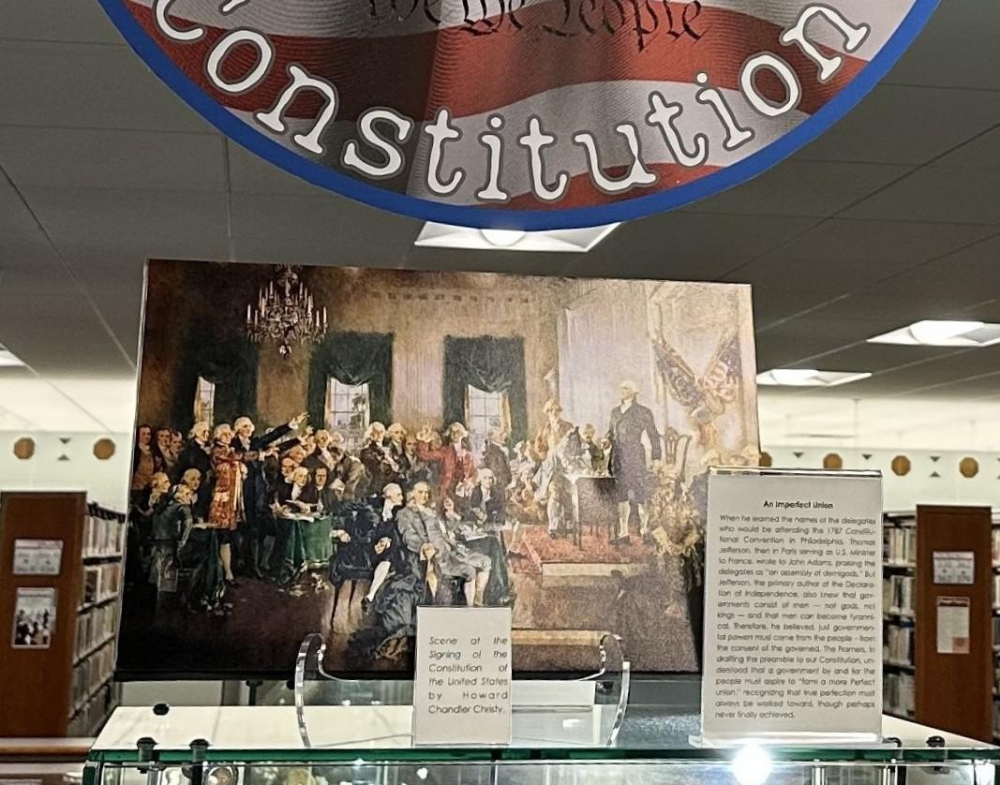 Atop the display case is a print of the painting "Scene at the Signing of the Constitution of the United States" by Howard Chandler Christy. It is meant to bring the Founding and Framing story full circle after starting with Trumbull's depiction of the Declaration.
An Imperfect Union
When he learned the names of the delegates who would be attending the 1787 Constitutional Convention in Philadelphia, Thomas Jefferson, then in Paris serving as U.S. Minister to France, wrote to John Adams, praising the delegates as “an assembly of demigods.” But Jefferson, the primary author of the Declaration of Independence, also knew that governments consist of men — not gods, not kings — and that men can become tyrannical. Therefore, he believed, just governmental powers must come from the people – from the consent of the governed. The Framers, in drafting the preamble to our Constitution, understood that a government by and for the people must aspire to “form a more Perfect union,” recognizing that true perfection must always be worked toward, though perhaps never finally achieved.
Amendments
Indeed, the 1787 convention delegates had the wisdom to create, in Article V of the Constitution a means by which the document could be amended to address errors or omissions, and to account for changing times. To date, our Constitution has been amended 27 times, the first 10 of which, known collectively as the “Bill of Rights,” were expressly added to protect citizens from their own government’s potential abuses of power.
"If in the opinion of the people, the distribution or modification of the constitutional powers be in any particular wrong, let it be corrected by an amendment in the way which the Constitution designates." - President George Washington, Farewell Address
A Second Founding
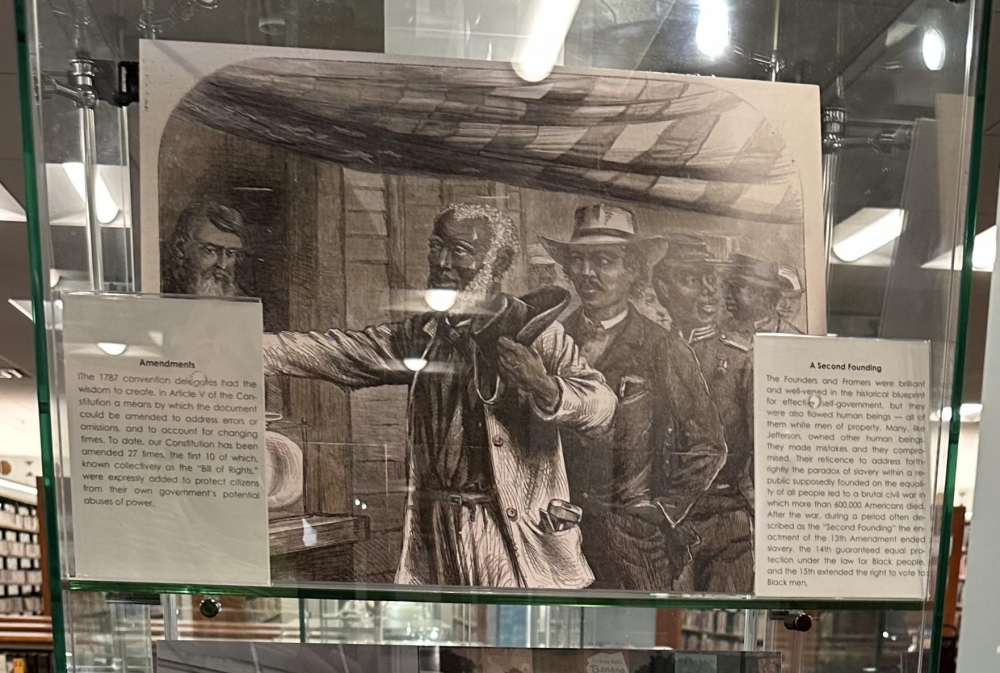 The Founders and Framers were brilliant and well-versed in the historical blueprint for effective self-government, but they were also flawed human beings — all of them white men of property. Many, like Jefferson, owned other human beings. They made mistakes and they compromised. Their reticence to address forthrightly the paradox of slavery within a republic supposedly founded on the equality of all people led to a brutal civil war in which more than 600,000 Americans died. After the war, during a period often described as the “Second Founding” the enactment of the 13th Amendment ended slavery, the 14th guaranteed equal protection under the law for Black people, and the 15th extended the right to vote to Black men.
A Betrayal
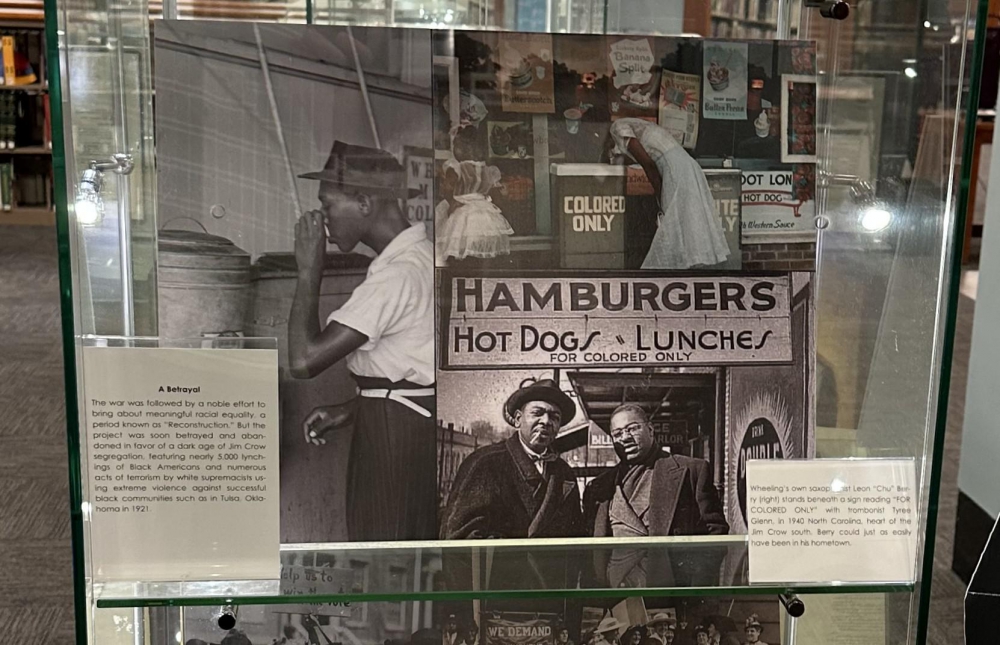
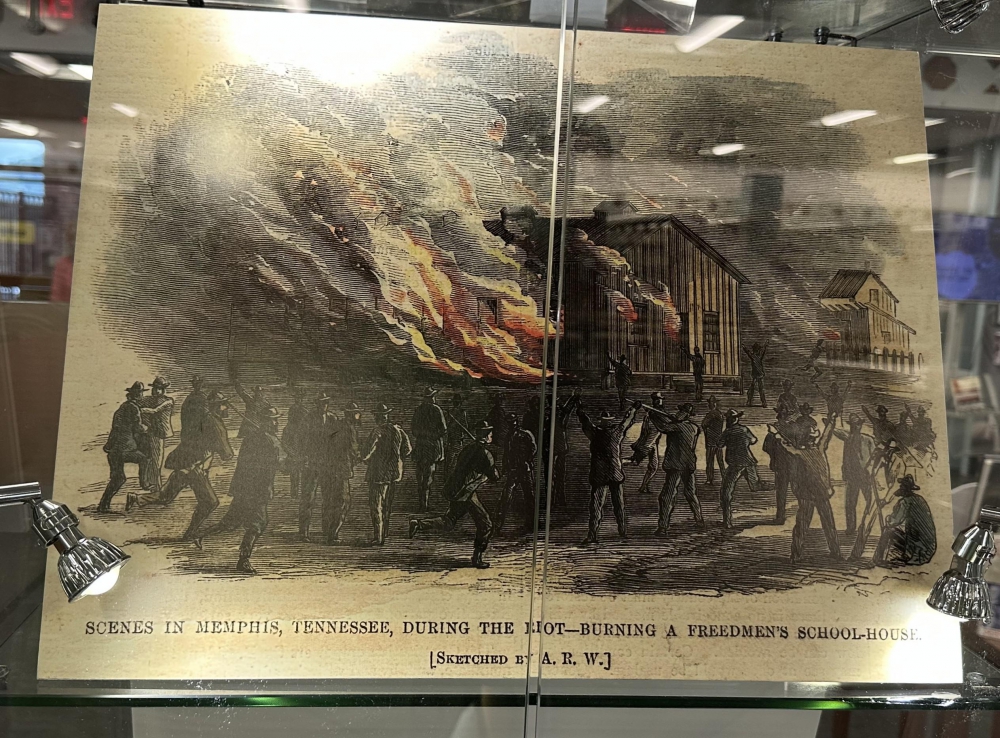 The war was followed by a noble effort to bring about meaningful racial equality, a period known as “Reconstruction.” But the project was soon betrayed and abandoned in favor of a dark age of Jim Crow segregation, featuring nearly 5,000 lynchings of Black Americans and numerous acts of terrorism by white supremacists using extreme violence against successful black communities such as in Tulsa, Oklahoma in 1921.
In the collage below, at bottom right, Wheeling’s own saxophonist Leon “Chu” Berry (right) stands beneath a sign reading “FOR COLORED ONLY” with trombonist Tyree Glenn, in 1940 North Carolina, heart of the Jim Crow south. Berry could just as easily have been in his hometown.
Native Rights, Suffrage & Civil Rights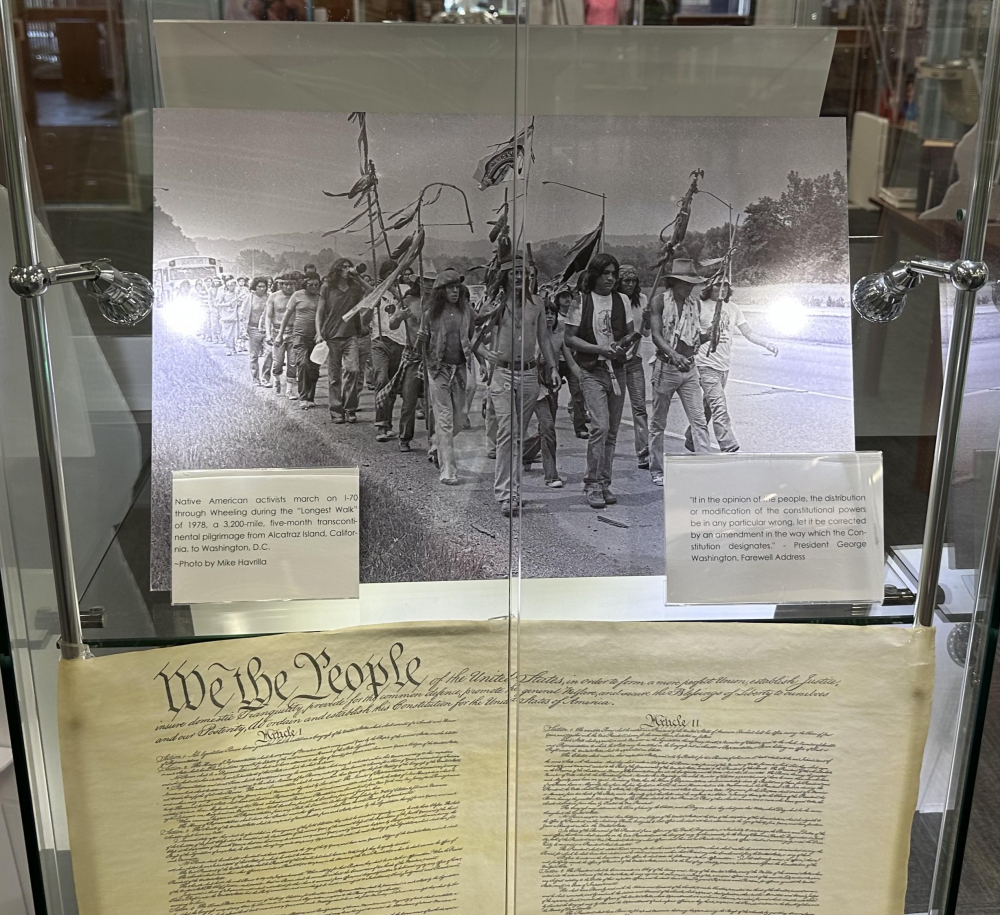
The original founding documents also did no favors for Indigenous people, who were persecuted and ill-treated throughout American history, only officially being named citizens in 1924. And it wasn’t until 1920, nearly a century and a half after the Constitution was ratified that the 19th Amendment extended the right to vote to women, and that only after heartbreaking decades of struggle and protest by suffragists and their allies. The Civil Rights Movement of the 1950s and 1960s fought for social justice and equality for African Americans and for all Americans. Its victories, hard won but tenuous, remain under assault to this day by those who would turn the clock back.
The photo at left by photographer Mike Havrilla, shows Native American activists marching on I-70 through Wheeling during the “Longest Walk” of 1978, a 3,200-mile, five-month transconti-nental pilgrimage from Alcatraz Island, California, to Washington, D.C. Below the image is a replica of the U.S. Constitution. These can be seen on the reverse of the last display case.
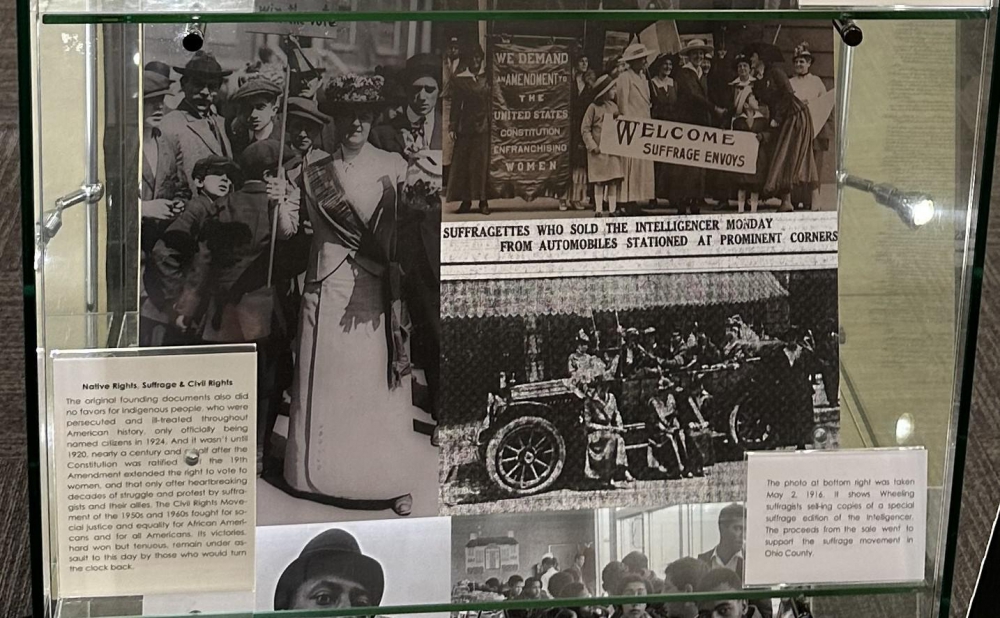
In the photo collage above, the image at bottom right was taken May 2, 1916. It shows Wheeling suffragists selling copies of a special suffrage edition of the Intelligencer. The proceeds from the sale went to support the suffrage movement in Ohio County.
In the collage below, again at bottom right, we see Wheeling’s Walter Reuther (left) a labor and civil rights leader, marching with Dr. Martin Luther King, Jr., in Detroit, 1963. Reuther was also the only white speaker during the March on Washington for Jobs and Freedom, where Dr. King delivered his "I have a dream" speech.
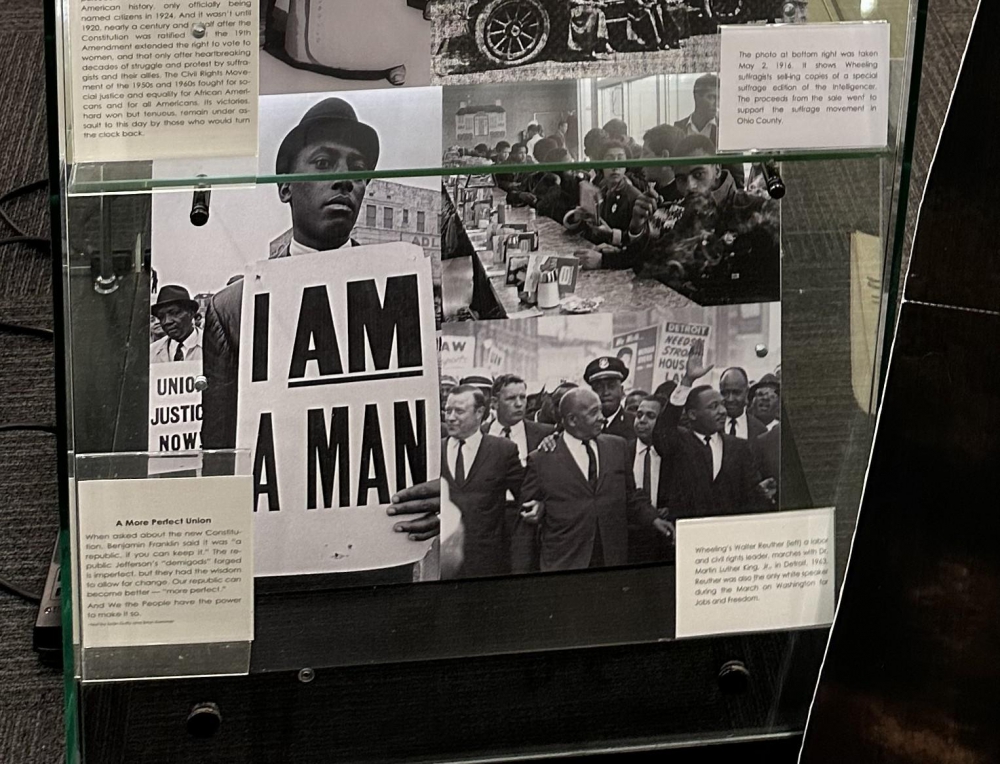
A More Perfect Union
When asked about the new Constitution, Benjamin Franklin said it was “a republic, if you can keep it.” The republic Jefferson’s “demigods” forged is imperfect, but they had the wisdom to allow for change. Our republic can become better — “more perfect.”
And We the People have the power to make it so.
~text by Seán Duffy and Brian Kammer
The Spirit of 1976
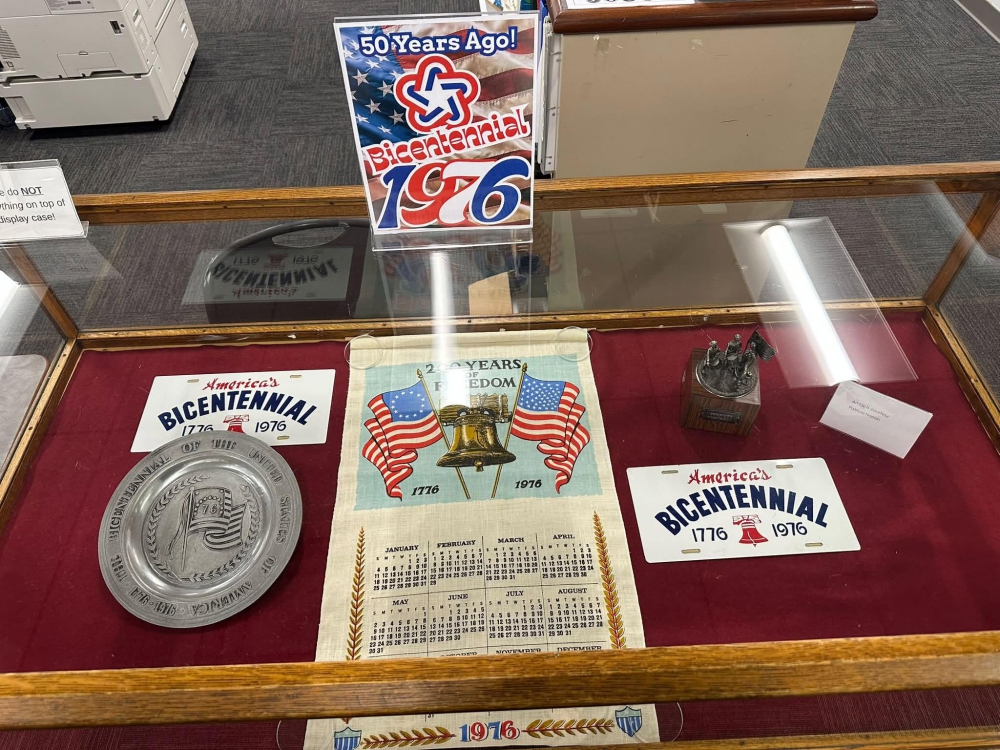
Don't miss our supplemental exhibit in the tabletop display near the Ref Desk. It recalls, with a touch of nostalgia, the Bicentennial celebration from 50 years ago in 1976.
Go to the OCPL's America 250 page.